

TL;DR — In Japan, AT&T International Day Pass and Verizon TravelPass charge $12/day to use your US plan on partner networks SoftBank or KDDI — that's $168 for 14 days. T-Mobile includes Japan for free on Magenta and Go5G plans, but throttles to 256 kbps after 5 GB (full 4G/5G only on Go5G Plus and Go5G Next). For most travelers, a dedicated Japan eSIM on the NTT Docomo network costs $25-50 for 14 days, keeps unlimited 4G/5G speed, and allows hotspot — the better speed-to-price ratio in 9 out of 10 cases.
AT&T International Day Pass in Japan: what you actually get for $12/day
AT&T's International Day Pass kicks in automatically the moment your iPhone or Galaxy connects to a Japanese partner network — typically SoftBank or KDDI rather than NTT Docomo. It's billed at $12 per day for the first device and $6 per day for each additional line on the same family plan. You keep your US number, your calls, your texts and your data drawn from your home plan — useful if you need to receive business calls or use your number for two-factor authentication codes.
The catch: those $12 trigger on the first activity — a single SMS received, a Gmail notification in the background, a Slack ping. On a 14-day trip, the bill climbs to $168 even if you only use 5 GB total. Real-world speeds on Japanese partner networks hover between 8 and 30 Mbps download according to OpenSignal data and Reddit r/JapanTravelTips reports. That's enough for Google Maps and Instagram, but a far cry from the 80 to 200 Mbps a Japan eSIM delivers directly on NTT Docomo.
AT&T also enforces an informal cap: beyond 5 GB consumed during international use, the carrier may throttle the connection to 128 kbps for the rest of the billing cycle. It's rarely advertised on the Day Pass marketing page, but it's there in the terms and conditions. A traveler doing 7 GB over two weeks across Tokyo and Kyoto will see their last 7 days become essentially unusable. To compare costs fast, check our Japan eSIM pricing guide: the same data costs 3-5x less.

Verizon TravelPass in Japan: $12/day too, but with speed nuances
Verizon TravelPass works on the same principle as AT&T: $12 per day to use your domestic plan in Japan, on partner networks SoftBank and KDDI. Billing starts on first activity — including a single iCloud notification — and runs 24 hours. Subscribers on Unlimited Plus or Unlimited Ultimate plans get what Verizon calls "optimized 4G LTE" speeds, but the carrier doesn't guarantee a specific floor. In practice, travelers testing in Shibuya, Namba, or around Narita report 5 to 25 Mbps on average, with drops to 1-2 Mbps during rush hour on the Yamanote Line.
Verizon adds a wrinkle: beyond 0.5 GB per day on certain offers, network prioritization may be reduced. Over 14 days at 0.5 GB daily, you can barely sustain Maps, WhatsApp and a bit of Instagram, but forget Netflix streaming on the Shinkansen or an HD FaceTime call with family in Boston. Verizon also touts unlimited calling to the US and Mexico during the TravelPass period — useful if you keep your number for work, irrelevant if you communicate via WhatsApp or iMessage.
The total comes out the same as AT&T: $168 for two weeks of partial roaming. And since Verizon doesn't cover certain rural areas of Tohoku or Hokkaido as well as Docomo (the Japanese partner is often SoftBank, which is more urban), you'll pay top dollar for sometimes lower coverage. If your itinerary includes Furano, Shirakawa-go, or the Japanese Alps, read our analysis of rural Japan coverage before you go: Docomo is significantly stronger.
T-Mobile Go5G and Magenta in Japan: the best US roaming offer, but with a strict cap
T-Mobile remains by far the most generous US carrier for Japan. Magenta, Magenta Max, Go5G and Go5G Plus plans all include free data in Japan. On standard Magenta and Go5G, you get 5 GB of high-speed 4G/5G, then unlimited speed throttled to 256 kbps. On Go5G Plus and Go5G Next, the high-speed allowance jumps to 15 or 50 GB — covering virtually any trip under three weeks without hitting the cap. No daily charge applies — it's bundled into your monthly US subscription.
On the ground, T-Mobile primarily uses SoftBank in Japan, occasionally KDDI depending on the area. High-speed performance reaches 30-80 Mbps download in Tokyo, Osaka and Kyoto — close to a SoftBank-based eSIM, but below the 100-200 Mbps measured on NTT Docomo. 5G works in major urban centers but stays rare in suburbs and absent in rural areas. Once the 5 GB are exhausted on Magenta, 256 kbps just barely keeps WhatsApp text and a zoomed-in Maps view alive in a familiar neighborhood, but not Maps in transit, Instagram Reels, or a video call.
For a short trip (5-7 days) with moderate use (Maps, photos, messages, light streaming), keeping T-Mobile Go5G Plus or Magenta Max at $0 extra makes a lot of sense and competes well with an eSIM. For a 2-3 week stay with heavier use (videos, hotspot, family connection sharing), the 5 GB cap arrives quickly — even Go5G Next at 15 GB can run dry in 7 days if you watch sports or download films. If you plan to use your phone as a hotspot for a MacBook, note that T-Mobile caps international tethering at 3G speeds — basically unusable for remote work.
Real-world speeds for the three US carriers in Japan: what travelers actually measure
Official numbers and reality often diverge. Here's what travelers report on OpenSignal, Speedtest.net and Reddit r/JapanTravelTips between 2024 and 2026, with measurements taken primarily in Tokyo (Shinjuku, Shibuya), Kyoto (Gion, Kyoto Station), Osaka (Namba, Umeda) and on the Tokaido and Tohoku Shinkansen lines.
AT&T International Day Pass averages 12 Mbps download and 4 Mbps upload on SoftBank, with 60-90 ms latency to US servers. That's fine for Maps, Spotify streaming, and 480p YouTube videos, but frustrating for remote work or uploading bulky photos to iCloud. Verizon TravelPass sits in the same range, with a slight Tokyo edge where Verizon apparently has better KDDI prioritization: 14 Mbps average, 5 Mbps upload. T-Mobile Go5G Plus, on its high-speed allowance, climbs to 45-65 Mbps download in major cities — the best US roaming option as long as you stay under the cap.
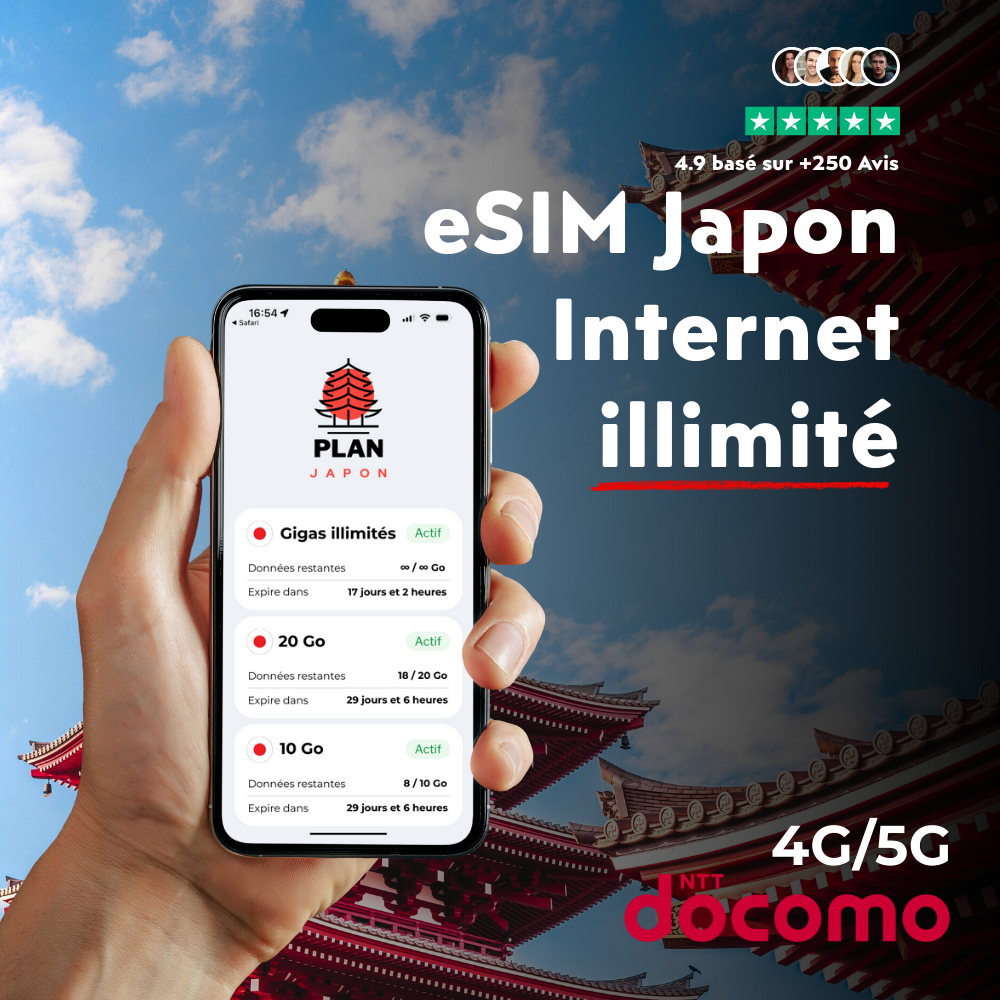
For direct comparison, a Japan eSIM on NTT Docomo (the network used by PlanJapan) consistently delivers 80 to 200 Mbps on 4G+ and up to 600 Mbps on 5G in covered areas. That's 4 to 10 times faster than AT&T or Verizon roaming. To understand why this gap is so wide, browse our comparative Japan eSIM speed test. Docomo's 5G now covers 99% of major cities and 85% of urban territory, where SoftBank and KDDI cap around 80-90% on 5G outside the capital.
Total cost on a 14-day trip: line-by-line bill comparison
Here's a concrete case: Sarah from New York travels 14 days in Japan, April 5-19, 2026. She visits Tokyo (5 days), Kyoto (3 days), Osaka (2 days), Hiroshima (1 day), Kanazawa (1 day) and spends 2 days in the Japanese Alps (Takayama, Shirakawa-go). Her usage profile: Google Maps continuously, iCloud Photos, Instagram, WhatsApp with family, 2-3 FaceTime calls, some Netflix on the Shinkansen. She estimates 12 GB total over 14 days.
With AT&T International Day Pass: 14 days × $12 = $168. Above 5 GB, throttling to 128 kbps — Sarah loses Maps in transit, FaceTime becomes impossible, and Instagram takes 30 seconds to load a story. With Verizon TravelPass: $168 too, with degraded prioritization beyond 0.5 GB daily on certain offers. With T-Mobile Go5G: $0 extra, but only 5 GB high-speed — the last 9 days spent at 256 kbps. With T-Mobile Go5G Plus at 15 GB: $0 extra and complete coverage, provided you pay $90/month in the US year-round.
With a 20 GB Japan eSIM for 30 days: roughly $25 to $35 on PlanJapan or a direct competitor — 5 to 7 times cheaper than AT&T's Day Pass. With an unlimited Japan eSIM: $40 to $60 for 14 days depending on the provider, hotspot included, full Docomo speeds. Sarah saves around $130 while doubling or tripling her speeds — and keeps her US number on the physical SIM for critical calls and SMS (banking, 2FA codes).
Hotspot, dual SIM, and work email: what US roaming silently blocks
Hotspot — sharing your phone's connection with a MacBook, iPad, or another phone — becomes critical during business or family travel. AT&T allows international hotspot on Day Pass, but counts hotspot data toward the 5 GB before throttling. Verizon limits international hotspot to degraded 3G speeds on most plans. T-Mobile, on standard Magenta and Go5G, caps international hotspot at 256 kbps — basically unusable for anything beyond a text email.
With a Japan eSIM, 4G/5G hotspot is generally included at full speed. PlanJapan, Holafly Premium and most direct competitors allow tethering with no special throttling as long as you stay within your data quota. For a digital nomad with MacBook + iPhone + iPad, that's the difference between working from a café in Daikanyama (50 Mbps) and struggling to load a webpage (256 kbps). Our comparison eSIM Japan vs international roaming details these gaps plan by plan.
The dual-use approach — keeping your US number for banking SMS while running a Japan eSIM for data — is the winning trick. On iPhone XS and newer, you activate the Japan eSIM as a secondary line and switch mobile data over to it, while calls and SMS stay on your primary AT&T/Verizon/T-Mobile US line. No voice roaming triggered, no Day Pass, no surprise on the bill. That's exactly the scenario we walk through in our guide on dual SIM eSIM in Japan, step by step on iOS and Android.
When to keep US roaming and when to switch to a Japan eSIM
Not every traveler faces the same calculus. If you subscribe to T-Mobile Go5G Plus or Go5G Next for a sub-10-day trip with moderate use (Maps, photos, messages, little streaming), keeping included roaming makes sense: $0 extra, decent speeds, maximum simplicity. Same story for a business weekend in Tokyo where you absolutely need to answer a US number — the $12/day Day Pass over 3 days stays reasonable ($36).
However, as soon as the trip exceeds 10 days, as soon as you travel as a couple, group or family with multiple phones, as soon as you plan to use hotspot for work or watch a movie via wifi-share on the Shinkansen, the Japan eSIM becomes mathematically the better deal. A family of 4 on AT&T pays $12 + $6 + $6 + $6 = $30/day, or $420 over 14 days. The same family with 4 Japan eSIMs at 20 GB: $100-140 total. The gap runs into hundreds of dollars on a single trip.
The smartest play: combine both. Activate your Japan eSIM as your primary data line (Docomo, full speeds, low price) and keep your US line active without international roaming — only to receive critical SMS (banking, 2FA, family emergencies). On iPhone, switch "Cellular Data" to the Japan eSIM and turn off "Data Roaming" on the US line. No fees trigger on the US side, your number stays SMS-reachable for short bursts, and you get the best Japanese coverage. To get started, check our top 10 best Japan eSIMs in 2026.
Edge cases: cellular Apple Watch, iPad, and accidental triggers
A cellular Apple Watch tied to AT&T, Verizon or T-Mobile shares the iPhone's number. If the iPhone is roaming in Japan, the watch is too — and background notifications can trigger the Day Pass at $12 even if you never tap the screen. Workaround: enable airplane mode on the watch as soon as you land, or temporarily suspend the cellular line (free for 30 days on certain AT&T plans). Same logic for cellular iPads — each line triggers its own Day Pass.
Accidental triggering is the most common pitfall. Apple, Google and Microsoft apps sync in the background the moment you land: iCloud Photos uploads your shots, Gmail pulls your email, Google Drive backs up your contacts. Five minutes of activity is enough to trigger the $12 charge even if you planned to stay on hotel wifi all day. Solution: switch on airplane mode upon landing, disable data roaming, then activate only your Japan eSIM and wifi.
Travelers landing at Narita or Haneda can install their Japan eSIM before departure (ideally 24-48 hours before) and activate it on landing: stepping off the plane, you're connected to 4G/5G Docomo in under 30 seconds, no SIM counter, no Day Pass charge. That's the procedure we recommend to every US-based traveler: pre-install at home, activate on landing, disable US roaming on the other line. Zero stress, zero surprise on next month's bill.
FAQ: Japan eSIM vs AT&T / Verizon / T-Mobile US roaming
Does my T-Mobile Magenta plan really include Japan for free?
Yes, but with an important nuance. Magenta includes 5 GB of high-speed 4G/5G in Japan, then drops to 256 kbps for the rest of the billing cycle. For a sub-week trip with moderate use, that's typically enough. On Magenta Max or Go5G Plus, you get 15 GB high-speed, covering most 2-3 week trips. No extra cost beyond your monthly US bill.
Does AT&T's International Day Pass trigger automatically in Japan?
Yes, on the very first activity (sending an SMS, receiving a notification, using Maps) on a Japanese partner network. The pass charges $12 for 24 hours of unlimited use from your home plan. To avoid it, switch on airplane mode on landing, disable data roaming, and use only your Japan eSIM or hotel wifi.
Can I use my US iPhone with a Japan eSIM?
Yes, as long as your iPhone is unlocked. iPhones sold by AT&T, Verizon and T-Mobile US are now unlocked by default (since 2018-2019 depending on the carrier and model). If you're unsure, check via Settings → General → About → SIM Lock. All iPhone XS and newer support eSIM, and most can run two lines simultaneously (your US line + the Japan eSIM). Our iPhone compatibility guide details supported models.
How much can I save by switching from US roaming to a Japan eSIM?
For a 14-day trip the math is simple: $168 with AT&T or Verizon Day Pass versus $25 to $60 with a Japan eSIM (depending on whether you pick 20 GB or unlimited). Net savings: $100 to $140. For a family of 4, the gap climbs to $300-400 per trip. On T-Mobile Go5G Plus, the eSIM only matters if you exceed 15 GB high-speed or want full-speed hotspot.
Which Japanese network does each US carrier use in Japan?
AT&T relies primarily on SoftBank, secondarily on KDDI depending on area. Verizon uses SoftBank with some KDDI agreements. T-Mobile mostly routes via SoftBank. None of the three US carriers use NTT Docomo, which has the best rural coverage and the highest speeds. A Japan eSIM sold by PlanJapan uses NTT Docomo directly — hence the performance gap we measure in rural areas and on the Tohoku Shinkansen.
Does hotspot work on AT&T / Verizon / T-Mobile roaming in Japan?
Yes, but throttled. AT&T allows hotspot within the 5 GB Day Pass cap, then throttles. Verizon limits international hotspot to degraded 3G speeds. T-Mobile caps international hotspot at 256 kbps on Magenta and standard Go5G. For a digital nomad or family wanting to share connection across multiple devices, a Japan eSIM with full 4G/5G hotspot remains far superior.
What happens if I cross from Tokyo to Hokkaido on the Shinkansen with US roaming?
Coverage varies by Japanese partner. SoftBank (used by AT&T, Verizon, T-Mobile) covers Tokyo-Sendai-Morioka but can lose signal in mountains or Tohoku tunnels. NTT Docomo offers the best signal continuity on the Shinkansen, making a Docomo-based Japan eSIM more reliable for streaming, remote work or GPS tracking en route. Our Shinkansen eSIM connection guide details critical zones.
 Airalo
 Holafly
 Saily
Saily Nomad
Nomad Ubigi
Ubigi