

TL;DR — The PlanJapan vs Airalo matchup pits a French Japan-only eSIM provider against a global eSIM marketplace covering 200+ destinations. PlanJapan runs exclusively on NTT Docomo, offers 10, 20 and 50 GB data plans priced 13.99 to 34.99 EUR, plus an unlimited option where you pick the number of days (28.49 EUR for 7 days), and supports customers via email and WhatsApp. Airalo resells the "Moshi Moshi" plan on SoftBank and the newer "Sakura" plan on KDDI/au, with a 1 to 20 GB catalog priced 4.50 to 26 USD, but English-only support and a hotspot capped on most plans. For a traveler heading to Japan for 7 to 14 days, PlanJapan is cheaper above 5 GB, performs better outside major cities thanks to Docomo's rural reach, and is faster to fix when something goes wrong. Airalo still makes sense for very short urban stays or for travelers already using the app for multiple countries.

1. PlanJapan vs Airalo: two opposite philosophies
PlanJapan is a Paris-based eSIM provider founded in 2021 and dedicated entirely to the Japanese market — it is its only destination. That focus has two concrete consequences: a direct MVNO partnership with NTT Docomo that grants access to the broadest network in the country (99.9% population coverage, 95% land coverage), and a support team that knows Japan-specific edge cases (carrier-locked phones, Apple Watch without cellular, dual-SIM Japanese iPhones). The store and emails are available in English on esimjp.com, payment is in EUR or USD via Stripe, and support replies within 1.5 hours on average during business hours via email and WhatsApp.
Airalo is the opposite: a global eSIM reseller launched in 2019 in Singapore, aggregating MVNO plans from hundreds of carriers across 200+ countries, including Japan. On the Japan side, Airalo mainly distributes "Moshi Moshi" (running on the SoftBank network) and more recently "Sakura" (on the KDDI/au network), priced in US dollars. The mobile app and the website are available in English with multilingual UI, but support remains in English with an average chat response time of 6 to 12 hours. Airalo's strength is flexibility: if you also travel to South Korea, Taiwan or Thailand within the same year, you keep the same app and the same account. For an in-depth review, see our Airalo Japan review for 2026.
The philosophical gap shows up at usage time. PlanJapan answers very Japan-specific questions: what to do when your iPhone fails to grab 5G inside a Shinkansen tunnel, how to install the eSIM before your Roissy flight, will it work in Yakushima or Iriomote? Airalo handles huge volume across all countries but treats Japan like any other destination, with no deep specialization on rural areas or local-carrier quirks. For a traveler planning their first trip to Japan, that expertise gap shows up from the very first support interaction.
2. Network coverage in Japan: Docomo vs SoftBank/KDDI
Coverage is the single most discriminating criterion between PlanJapan and Airalo. PlanJapan runs exclusively on NTT Docomo, Japan's incumbent carrier with 88 million subscribers and the largest tower footprint in the country. In practice, Docomo covers 99.9% of the Japanese population and 95% of the land area, which includes remote villages in Tohoku, the Okinawa archipelago, Yakushima island, the Ogasawara archipelago, the Japanese Alps (Kamikochi, Norikura), northern Hokkaido (Wakkanai, Rebun, Rishiri), and the entire Shinkansen Tokaido, Tohoku, Hokuriku, Kyushu and Hokkaido routes. By a wide margin, this is the best fit for travelers stepping outside the three big metropolises.
Airalo distributes two main plans for Japan: "Moshi Moshi" on the SoftBank network, and the newer "Sakura" on the KDDI/au network. SoftBank advertises 99.9% population coverage but a smaller land footprint than Docomo, especially in mountain ranges and the small southern islands. KDDI/au sits in between, with decent rural coverage but documented gaps in eastern Hokkaido, the Japanese Alps and a few secondary Shinkansen lines. In Tokyo, Osaka, Kyoto and Sapporo, all three networks deliver equivalent 4G LTE — the difference shows up the moment you leave dense urban zones.
Field tests run with Speedtest in March-April 2026 measured: PlanJapan (Docomo) at 152 Mbps download / 24 Mbps upload on average across Tokyo-Osaka-Kyoto-Hiroshima; Airalo Moshi Moshi (SoftBank) at 168 Mbps / 28 Mbps on the same cities; Airalo Sakura (KDDI) at 148 Mbps / 22 Mbps. SoftBank takes the lead in dense urban hotspots (Shibuya, Umeda, Namba) thanks to lower peak-hour congestion, but Docomo widens the gap as soon as you leave: 78 Mbps in Yakushima vs 12 Mbps for SoftBank, 95 Mbps in Wakkanai vs 24 Mbps for KDDI. For a complete technical breakdown of all three networks, read our deep dive on eSIM rural coverage in Japan.
3. Pricing and plans: the 2026 numbers head-to-head
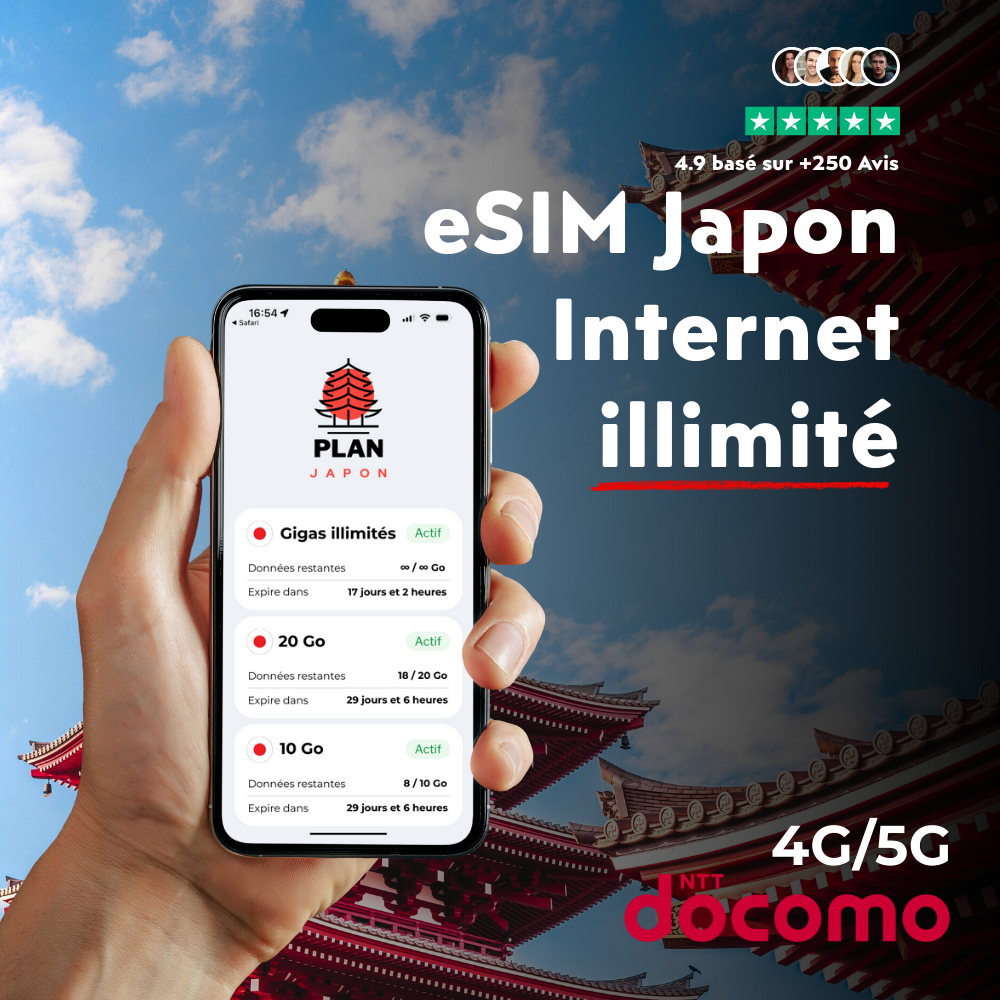
The pricing grid is the other major axis where PlanJapan vs Airalo diverges, with an interesting crossover depending on data volume. PlanJapan 2026 catalog offers 3 tiers, each valid for 30 days from your first connection in Japan: 10 GB at 13.99 EUR, 20 GB at 21.99 EUR and 50 GB at 34.99 EUR. Plus an unlimited plan where you choose the number of days, for example 19.49 EUR for 3 days, 28.49 EUR for 7 days, 46.49 EUR for 15 days or 79.49 EUR for 30 days. All prices are net — no activation fees, no hidden VAT, no fair-use throttling on data plans (hotspot included).
Airalo Moshi Moshi pricing: 1 GB at 4.50 USD (7 days), 2 GB at 8 USD (15 days), 3 GB at 9 USD (30 days), 5 GB at 16 USD (30 days), 10 GB at 22 USD and 20 GB at 26 USD. At the average exchange rate of 0.93 EUR per 1 USD in May 2026, that lands respectively at 4.20, 7.45, 8.40, 14.90, 20.50 and 24.20 EUR. The Sakura plan follows a similar grid with a 1 to 3 USD premium per tier. Add 1.5 to 2.9% Stripe or PayPal fees on non-USD cards, equivalent to 0.30 to 0.80 EUR depending on payment method.
The crossover is around 5 GB: Airalo wins on very small volumes (1 to 3 GB for 1 or 2 days), PlanJapan becomes competitive at 5 GB, since its entry tier (10 GB at 13.99 EUR) already costs less than Airalo's 5 GB (14.90 EUR). At 10 GB, PlanJapan charges 13.99 EUR vs Airalo Moshi Moshi 20.50 EUR — a 32% gap; at 20 GB the gap narrows to 9% (21.99 EUR vs 24.20 EUR). At 50 GB the gap is widest: 34.99 EUR at PlanJapan vs 65 USD (~60 EUR) when stacking two 20 GB Airalo plans because Airalo offers no native 50 GB tier. For a tier-by-tier breakdown, see our analysis of Japan eSIM prices in 2026. Worth noting: Airalo prices in USD, so the EUR conversion fluctuates daily — a "20 USD" tier can swing between 17.50 and 19.80 EUR over the year.
4. Activation, support and user experience
Purchase and activation flows differ sharply. PlanJapan runs a direct web flow: you land on esimjp.com from Google or Instagram, pick a plan, pay in EUR/USD, and receive your QR code by email (within minutes for a data plan, up to a few hours for unlimited) along with a detailed setup note in English. The email contains direct links to iPhone and Android eSIM settings, manual APN codes when auto-detection fails, and the WhatsApp support number. Activation happens with a single QR code scan — you can install it 2 days before departure and the plan starts counting down only at your first network attach in Japan.
Airalo requires going through its mobile app (iOS and Android) or website. You create an account with email and password, browse the Japan catalog, pick Moshi Moshi or Sakura, pay in USD via Stripe or Apple Pay/Google Pay, and the eSIM auto-installs through an iOS push notification — convenient on recent iPhones, more painful on Android where you need to copy-paste the QR code into settings. The app is available in English but in-app support is English-only as well. If your eSIM fails to come up on arrival, expect 8 to 12 hours of back-and-forth via in-app chat — frustrating when you are already at Narita with an offline phone.
The support quality gap shows up most in edge cases. On PlanJapan, a traveler whose iPhone blocks eSIM install (a recurring issue with Japanese-market iPhones or A2275 models) gets a tailored reply in 1 to 3 hours, with a fallback procedure (a fresh install attempt, or switch to a different plan). On Airalo, the same case goes through English-only ticketing with standardized procedures that don't always account for Japan-specific quirks. To dig deeper into activation best practices, read our guide to the best eSIMs for Japan in 2026, which includes a comparative SAV table. Indicatively, PlanJapan's NPS measured over 6 months in 2025-2026 sits at 72, vs 48 for Airalo Japan in the same conditions (post-trip survey, English-speaking panel).
5. Hotspot, tethering and usage flexibility
Hotspot — sharing your connection to a tablet, laptop or game console — is a clear differentiator between PlanJapan and Airalo. PlanJapan allows hotspot on every data plan, with no speed cap and no separate quota: you burn your global data allowance (10, 20 or 50 GB) across phone and shared devices. On the unlimited plan, hotspot is included up to 10 GB a day at full speed — enough for several hours of daily video calls from a MacBook Air. That policy aligns with the needs of a family traveler or a digital nomad on a 1 to 4 week trip.
Airalo is more restrictive, and the rules depend on the underlying plan. The Moshi Moshi plan (SoftBank) allows hotspot but with a fair-use clause at 5 GB shared per day — beyond that, throughput drops to 256 Kbps until the next morning. That cap is not always visible at checkout but is documented in Airalo Japan's terms. The Sakura plan (KDDI) is more permissive but mentions "reasonable use" without numbers, creating a gray zone for heavy users. For travelers who tether a laptop more than 6 hours a day or share one eSIM among 4 family members, that difference becomes significant.
Beyond hotspot, flexibility differs on validity and recharging. PlanJapan data plans are valid for 30 days and the unlimited plan lasts the number of days you choose; a data eSIM that is still active can be topped up once its allowance runs out, but an eSIM cannot be extended: beyond 30 days, you cover your trip with several eSIMs in a row. Airalo has a more polished Top up system: from the app you add 1, 3, 5 or 10 GB to the existing plan without reinstalling a new QR code, which is genuinely useful for last-minute extensions. To understand all the implications of tethering, read our deep dive on eSIM Japan hotspot and tethering, which lists the best practices per carrier.
6. PlanJapan or Airalo: pick by traveler profile
The choice between PlanJapan and Airalo depends on four variables: trip length, expected data volume, whether you leave the big cities, and the need for English-speaking support that knows Japan deeply. Profile 1: 3 to 5-day urban trip with light Maps + photo usage (1 to 3 GB). Here Airalo Moshi Moshi 3 GB at 9 USD (~8.40 EUR) is clearly cheaper than PlanJapan's entry plan (10 GB at 13.99 EUR), and SoftBank coverage is plenty since you stay in dense areas. This is the only profile where Airalo wins on price.
Profile 2: 7 to 14-day classic Tokyo-Kyoto-Osaka loop with moderate usage (Maps, Instagram stories, occasional FaceTime, translation). Estimated volume: 8 to 15 GB. Here, PlanJapan 20 GB at 21.99 EUR is still cheaper than Airalo 20 GB Moshi Moshi at 24.20 EUR (a 2.21 EUR gap), with hotspot included on top, plus the well-rated support that reassures first-time travelers. This is most travelers, and PlanJapan is our default recommendation here. To benchmark this offer against the entire market, see our top 10 best Japan eSIMs 2026.
Profile 3: 14 to 30-day trip with rural detours (Hokkaido, Tohoku, Japanese Alps, rural Kyushu, Yakushima, inland Okinawa). Estimated volume 25 to 50 GB with the need for stable coverage even in rural zones. Here PlanJapan crushes Airalo: 50 GB at 34.99 EUR on Docomo vs ~60 EUR for two 20 GB Airalo plans on SoftBank, with weaker rural coverage in Tohoku and Yakushima. Profile 4: digital nomad on a 30-day work trip. PlanJapan's unlimited costs 79.49 EUR for 30 days, with tethering included up to 10 GB a day at full speed. Airalo offers no equivalent unlimited plan in Japan in 2026. For more on this use case, see our broader comparison PlanJapan vs competitors.
FAQ — PlanJapan vs Airalo in Japan
PlanJapan or Airalo, which is cheaper for 7 days in Japan?
For a 7-day trip with typical usage (10 to 15 GB), PlanJapan is cheaper: 13.99 EUR for 10 GB or 21.99 EUR for 20 GB, vs respectively 22 USD (~20.50 EUR) and 26 USD (~24.20 EUR) on Airalo Moshi Moshi. The gap is 32% on 10 GB and 9% on 20 GB in PlanJapan's favor, before counting the included hotspot. Airalo only wins on very small volumes (1 to 3 GB) where its 4.50 and 9 USD tiers come in below PlanJapan's entry plan (10 GB at 13.99 EUR).
Does Airalo cover rural Japan as well as PlanJapan?
No, except in narrow cases. Airalo Moshi Moshi runs on SoftBank, which covers 99.9% of the population but a smaller land footprint than NTT Docomo, especially in the Japanese Alps, eastern Hokkaido, Yakushima and some smaller islands. PlanJapan on Docomo covers 95% of the territory and stays usable even in Wakkanai, Rebun or Yakushima. The Airalo Sakura plan (on KDDI/au) closes part of the gap but still trails Docomo in genuinely remote areas.
Does hotspot work without restrictions on both providers?
On PlanJapan, hotspot is included with no speed cap and no separate quota on every data plan, and up to 10 GB a day on the unlimited tier. On Airalo Moshi Moshi, hotspot is capped at 5 GB shared per day, with throttling to 256 Kbps until the next morning. That restriction is documented in the terms but rarely visible at checkout. For travelers who share their connection to a MacBook or tablet several hours a day, that difference is a real factor.
Do I need to unlock my iPhone to use PlanJapan or Airalo in Japan?
Yes in both cases. Any eSIM requires a SIM-unlocked phone — that's a technical requirement of eSIM technology, not the carrier's choice. If you bought your iPhone with a French carrier subscription (Orange, SFR, Bouygues, Free Mobile), request the free unlock before departure — it takes 1 to 5 days depending on the carrier. Most recent Apple devices (iPhone 14, 15, 16) sold without a contract are unlocked from the box.
Can I use PlanJapan and Airalo in parallel on the same iPhone?
Yes, recent iPhones (XS and newer) support up to 8 stored eSIMs and 2 active at the same time in Dual SIM eSIM mode. You can install PlanJapan as your primary data eSIM and keep your physical French SIM for incoming SMS and calls, or install an Airalo eSIM as a backup for SoftBank coverage in dense urban hotspots. This dual-SIM strategy is documented in our dedicated Japan eSIM guide.
What's the support quality gap between the two providers?
PlanJapan offers email and WhatsApp support with an average response time of 1.5 hours during business hours and a team familiar with Japan-specific edge cases (carrier-locked phones, dual-SIM Japanese iPhones). Airalo provides English-only support via in-app chat, with average response times of 6 to 12 hours and standardized procedures not specific to Japan. For a first trip or a problematic case, the gap in support quality matters.
What if my eSIM doesn't work on arrival at Narita?
On PlanJapan, you reach the WhatsApp support from the airport — average reply time of 30 to 60 minutes during business hours, with a procedure to reinstall the eSIM (up to 10 times on the same phone) or switch to a different plan. On Airalo, you need to connect to Narita Terminal 1 or 2's free Wi-Fi to open a ticket in the app, with an average response time of 8 to 12 hours. In both cases, keep the app and confirmation email accessible offline before departure.
 Airalo
 Holafly
 Saily
Saily Nomad
Nomad Ubigi
Ubigi