

TL;DR: Planning a 2026 trip to Japan comes down to five concrete decisions before booking flights: when to go (sakura late March-early April, koyo late November, avoid Golden Week April 29 to May 6), what paperwork to bring (passport valid 6 months, Visit Japan Web mandatory at immigration since 2024), how much to budget (€1,800-2,500 per person for 14 days excluding flights, hotels in central Tokyo), how to move around (7-day JR Pass at 50,000 JPY since October 2023, roughly €300, plus a mandatory Suica/Pasmo IC card) and how to stay connected (NTT Docomo 4G/5G eSIM working from the second you land at Narita or Haneda, no airport queues). This guide covers each of these with verified 2026 numbers, tested 1-3 week itineraries and the pitfalls to avoid.
When to visit Japan in 2026: the season changes everything
Japan is not a year-round destination — the experience gap between a spring cherry blossom trip and a sticky August in Tokyo (35 °C, 80 % humidity) is wide enough to justify aligning your dates with what you actually want to see. The 2026 sakura window stretches from March 22 (Fukuoka, Kyushu) to April 12 (Tohoku, Hokkaido) according to the latest forecast published by the Japan Meteorological Corporation in February 2026 — Tokyo and Kyoto peak around March 25 to April 2, when flights and hotels rise 40-60 % above off-season prices. For autumn foliage hunters, the koyo season runs from late October (Hokkaido) to mid-December (Kyoto, Nikko), peaking in Kyoto between November 20 and 30.
The periods Western travellers should avoid: Golden Week (April 29 to May 6, 2026), Obon week (August 13-16) and Japanese New Year (December 29 to January 3). Shinkansen trains are packed, ryokan are full three months in advance and some museums close. On the other hand, mid-May to late June and early September to mid-October offer the best weather-to-crowd-to-price ratio — it rains a few days in June (tsuyu, the rainy season), but the country empties and rates fall back to baseline. Our detailed guide to the best season to visit Japan compares all 12 months with temperatures, events and average prices.
Once you have picked the season, plan 4-6 months ahead for flights (Paris-Tokyo on Air France or ANA in economy: €750-1,200 depending on the date, with a dip in November), 3-4 months for hotels in high season and 2-3 months for the JR Pass (still available from abroad, plus regional pass options for shorter loops). Setting up your Japan eSIM 7-10 days before departure lets you install the profile calmly and test the QR code at home before you ever reach the airport.

Visa, passport and Visit Japan Web: the 2026 paperwork
Citizens of the United States, Canada, the United Kingdom, Australia, New Zealand, Singapore, and most EU countries enjoy a visa waiver for tourist stays of up to 90 days. The only upstream requirement: a passport valid for at least 6 months after your return date, with two blank facing pages. No visa, no paper form at the airport — but since November 2024, the paperless Visit Japan Web procedure has become the de facto standard at Narita, Haneda, Kansai (KIX) and Chubu (NGO). You file your immigration declaration and your customs declaration 3 to 7 days before departure, then show two QR codes at arrival — which saves 30 to 45 minutes versus manual queues, especially in high season.
In practice, plan to have your PlanJapan eSIM active and working the moment you step off the plane: the Visit Japan Web portal needs internet to display your final QR codes, and the free WiFi inside Japanese airports remains slow and limited to 30 minutes per session. If you arrive at Narita Terminal 1 at 2 pm on a March Sunday, VJW saves you 25-40 minutes in the immigration line, potentially the difference between catching the last Narita Express to Tokyo Shinjuku and waiting for the next slot. Our eSIM activation guide for Narita and Haneda walks through the procedure terminal by terminal.
On the health side, no vaccine is required to enter Japan in 2026 — COVID-19 controls were lifted in May 2023. Travel insurance covering overseas medical costs is still strongly recommended: a single night in a Japanese hospital runs 30,000 to 80,000 JPY (US$200 to US$550) before procedures, and most domestic health cards are not honoured. Also remember to print your hotel reservations (customs sometimes asks), your return ticket and the full address of your first night — Visit Japan Web wants it in kanji, romaji and with a Japanese phone number (the hotel's number is enough).
How much does a trip to Japan cost in 2026: realistic budget by profile
Japan long carried a reputation as an expensive destination — the 2026 reality is more nuanced thanks to a still-weak yen (1 USD = 150-155 JPY, 1 EUR = 165-170 JPY since mid-2024). For a 14-day couple's trip, excluding flights, a "mid-range comfort" budget sits between €3,500 and €5,000 for two, or €1,750-2,500 per person. That covers 3-4 star hotels in good locations (8,000-15,000 JPY per double room, or €50-90), three meals a day mixing izakaya, conbini (Family Mart, 7-Eleven, Lawson) and one nicer restaurant every 2-3 days, urban transport via IC card (Suica/Pasmo), a 7 or 14-day JR Pass for Shinkansen travel, and entry tickets to temples, museums and parks.
For a budget profile (hostels like Khaosan, basic suburban ryokan, conbini lunches and casual dinners, regional transport without a national JR Pass), plan €1,100-1,400 per person over 14 days. For a premium profile (Park Hyatt Tokyo, Aman Kyoto, Michelin-starred sushi like Saito, taxis and chauffeured cars, private tea ceremony experiences), budget €8,000-15,000 per person — Japan has a very high ceiling without ever feeling absurd. The line that surprises most: long-distance transport. A one-way Shinkansen from Tokyo to Kyoto costs 14,170 JPY in 2026 (US$95 / €85), or roughly €170 round trip versus a 7-day JR Pass at 50,000 JPY (€300) — profitability depends on your itinerary.
For connectivity, the Japan eSIM remains the cheapest, simplest option: US$15-40 (or €14-35) for 7-30 days depending on the plan, around US$1-3 per day, versus US$4-7 per day for an airport Pocket WiFi rental (Sakura Mobile, Japan Wireless) and far more for foreign carrier roaming (AT&T, T-Mobile, EE, Vodafone often charge US$10-15 per day with a 1 GB cap). Our Japan eSIM pricing breakdown for 2026 compares 7, 15 and 30-day plans, capped data versus unlimited.
Getting around: JR Pass, Shinkansen, metro and IC cards
The Japanese rail network is still one of the most efficient in the world — 99 % of trains arrive on time to the second, and 3-minute transfers between Shinkansen and metro are the norm. The system splits into three layers: JR lines (national, operated by six regional JR companies — JR East, JR Central, JR West and others), private lines (Hankyu, Keio, Tokyu, Odakyu, Hanshin) and urban metros (Tokyo Metro, Toei, Osaka Metro). The national JR Pass, valid on all JR lines and most Shinkansen (except Nozomi and Mizuho, which require an extra fare), costs 50,000 JPY for 7 days, 80,000 JPY for 14 days and 100,000 JPY for 21 days since the October 2023 price revision. It pays off if you do at least Tokyo-Kyoto-Osaka-Hiroshima round trip, otherwise it does not.
Before riding any metro, get a digital IC card: Suica (JR East, dominant in Tokyo), Pasmo (equivalent, interoperable), ICOCA (JR West, dominant in Kyoto-Osaka). All work nationwide since the 2013 harmonisation. On iPhone, Suica and Pasmo load into Apple Wallet in 3 minutes and top up by credit card — the simplest path for Western travellers. On Android (Pixel, Samsung), only Suica via Google Pay works from outside Japan, with some constraints. Without an IC card you buy a single ticket at every gate (sometimes from machines only in Japanese), which eats up time at every transfer.
For the Shinkansen specifically, on-board internet is uneven. The Tokaido line (Tokyo-Nagoya-Kyoto-Osaka) offers free WiFi that is mediocre (5-15 Mbps, cut in tunnels), while the newer N700S trains carry stable 4G/5G through the Docomo network. With an active Japan eSIM your phone stays connected almost the whole route except for 2-3 long tunnels around Mishima and Atami. Our guide on eSIM connection in the Shinkansen details the coverage line by line (Tokaido, Tohoku, Kyushu, Hokuriku).
Staying connected: eSIM, Pocket WiFi or public WiFi
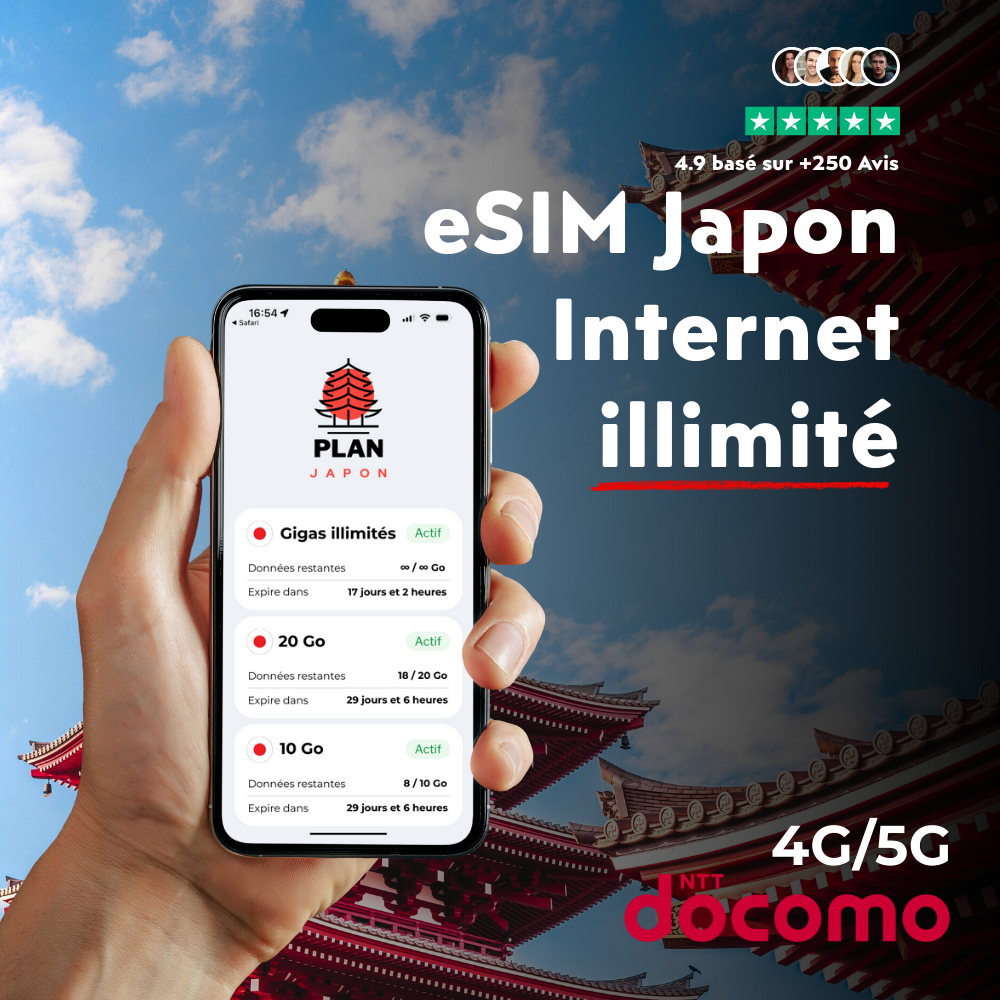
Three options share the Japanese connectivity market in 2026, with very different cost and convenience curves. The Japan eSIM has dominated since 2023 for travellers with an iPhone XS or newer and most modern Android devices (Pixel 4+, Galaxy S20+, recent Xiaomi and OnePlus): US$15-40 for 7-30 days depending on volume, set up in 2 minutes with a QR code, no hardware to carry, hotspot included. The Pocket WiFi remains relevant for groups of four or more or for phones that are not eSIM-compatible: US$4-7 per day, picked up and returned at the airport counter (Sakura Mobile at Narita Terminal 1, Japan Wireless at Haneda), with a battery to recharge every night. Public WiFi (JR stations, conbini, Starbucks, recent metro lines) covers emergencies but is slow (5-20 Mbps), inconsistent geographically and often demands a sign-up in Japanese.
For a single traveller or a couple with a compatible phone, the eSIM is the obvious choice: cheaper, faster to activate, no hardware to carry, working from Narita or Haneda. For a family of four with kids on tablets, the math shifts: a shared 50 GB eSIM hotspot costs US$41.99, versus US$70-100 for a Pocket WiFi over 14 days, but the eSIM drains the host phone battery (3-4 hours of intensive hotspot). The hybrid setup — PlanJapan eSIM for parents plus a Pocket WiFi for the kids — works very well on 2-3 week trips.
The Docomo network, PlanJapan's partner, covers 99.9 % of Japanese territory including the rural Tohoku, northern Hokkaido, mainland Okinawa, the Japanese Alps (Kamikochi, Hakuba) and the Kii valleys. The rare blackspots: a few long tunnels, portions of Iriomote island (Okinawa) and peaks above 2,500 m outside ski resorts. Our comparison of the best Japan eSIMs ranks PlanJapan against Airalo, Holafly, Ubigi and Saily on speed, tethering, support and price for 2026.
Sample itineraries by trip length
The classic mistake when planning a first trip to Japan is trying to see everything — the 47 prefectures span 3,000 km north-south, and a Tokyo to Hokkaido train ride eats a full day. For 7 days, stay on the Tokyo (3 nights) + Kyoto (2 nights) + Osaka (1 night) axis, with a day trip to Nara from Kyoto and Shinkansen for the transfers. You see the must-sees — Shibuya, Asakusa, Meiji Jingu, Fushimi Inari, Kinkaku-ji, Dotonbori — without burning out. Our guide on a Japan eSIM for 1 week sizes the plan for this itinerary (10-15 GB is plenty).
For 14 days, add Hiroshima and Miyajima as a Kyoto-Tokyo round-trip side leg (1 day round trip or 2 nights on site), Hakone for onsen and a Fuji-san view (1-2 nights), and a detour to Kanazawa or Takayama-Shirakawago for the Japanese Alps (2 nights). Plan US$3,000-3,800 per person in mid-range comfort for 14 nights including JR Pass 14 days, hotels, meals and entries. The "polished" itinerary: Tokyo (4 nights) → Hakone (1) → Kyoto (3) → Osaka/Nara (1) → Hiroshima/Miyajima (1) → Kanazawa (1) → Tokyo (2 nights before flying out).
For 21 days and beyond, you unlock Hokkaido (Sapporo + Otaru + Hakodate or Niseko in winter) or Okinawa (Naha + Zamami island) on top of the classic loop. Three weeks also opens up the deep south (Kyushu: Fukuoka, Kumamoto, Beppu/Yufuin, Kagoshima) and the underrated Tohoku (Sendai, Matsushima, Hirosaki). At that length the unlimited Japan eSIM becomes preferable to a capped plan — the price difference is dwarfed by the absence of data anxiety on 21 straight days of daily mobility. Our guide on Japan eSIM for 3 weeks details typical data volumes by profile.
Accommodation, payment, etiquette: cultural codes to know
Accommodation in Japan covers a variety unmatched in the West: business hotels like APA or Toyoko Inn (5,500-8,000 JPY per night, clean and functional 12 m² rooms), mid-range hotels like Mitsui Garden and Daiwa Roynet (10,000-16,000 JPY), traditional ryokan with onsen and kaiseki dinner (18,000-50,000 JPY per person on half-board, a must at least once), capsules of the new generation like 9 Hours or Nine Hours (3,500-6,000 JPY, clean, well-designed, perfect for 1-2 nights in transit), and AirBnb / minpaku regulated since the 2018 law (variable quality, check the licence). Book 3-4 months ahead on Booking, Agoda, Rakuten Travel or Jalan for high season, 2-3 weeks ahead in low season.
On the payment side, Japan in 2026 is still more cash-driven than people expect: Visa and Mastercard work in 80 % of hotels, chain restaurants and department stores, but not in small izakaya, temples, some taxis or local markets. Withdraw yen systematically from 7-Eleven or JP Post Bank ATMs (the only ones accepting foreign cards 24/7, no hidden fees beyond your home bank's). American Express and Diners are accepted less widely than Visa and Mastercard. Tipping does not exist and can even offend — leaving a bill on the table is read as forgetfulness, and the waiter will chase after you.
Etiquette matters more than visitors expect. Never plant chopsticks vertically in a rice bowl (a funeral reference), remove shoes before entering a ryokan or onsen, no phone calls on the metro or Shinkansen, keep tattoos covered in public onsen (increasingly tolerated but still cause for refusal in some places). To anticipate these points and pack accordingly, see our guides on Japan packing list and best Japan travel apps for 2026 — Google Maps, Google Translate with camera, Suica Wallet, NaviTime Transit and Tabelog are the five apps that genuinely transform the daily experience.
FAQ — Planning a Japan trip in 2026
Do I need a visa to travel to Japan in 2026 from the US or EU?
No. Citizens of the United States, Canada, the United Kingdom, Australia, New Zealand, Singapore and most EU countries enjoy a visa waiver for tourist stays of up to 90 days. You only need a passport valid at least 6 months after your return date. Since 2024, Visit Japan Web has become the standard to save time at immigration: online registration 3-7 days before the flight, then QR codes to show on arrival at Narita, Haneda, Kansai or Chubu airports.
When is the best time to visit Japan in 2026?
The two most popular windows are late March to early April for sakura (full bloom in Tokyo and Kyoto around March 25 to April 2, 2026) and late November to early December for koyo (red maples, peak in Kyoto around November 20-30). For the best quality/price/crowd ratio, target mid-May to late June (accepting a few rainy days) or early September to mid-October. Avoid Golden Week (April 29 to May 6), Obon (August 13-16) and Japanese New Year (December 29 to January 3).
How much does a 2-week trip to Japan cost in 2026?
For a mid-range couple (3-4 star hotels, mixed izakaya/conbini/nicer restaurants, JR Pass 14 days), plan US$3,800-5,500 for two excluding flights, or US$1,900-2,750 per person. On a tight budget (hostels, conbini, regional transport without a JR Pass), US$1,200-1,500 per person. In premium (Park Hyatt, starred restaurants, VIP experiences), US$8,500-16,000 per person. The still-weak yen (1 USD ≈ 150-155 JPY) makes Japan noticeably more affordable than before 2022.
Is the JR Pass still worth it after the October 2023 price hike?
Yes, but the math has tightened. At 50,000 JPY for 7 days (US$330 / €300), the JR Pass pays off if you do at least a Tokyo-Kyoto round trip (28,340 JPY) plus 1-2 long-distance segments (Hiroshima 22,000 JPY one-way, Hakone-Kyoto 13,000 JPY). For a plain Tokyo-Kyoto-Osaka itinerary with no far-flung side trip, individual tickets (44,000 JPY) come out cheaper. The "regional pass" JR East (20,000 JPY) or JR West Kansai-Hokuriku (19,000 JPY) is often smarter on shorter loops.
Which eSIM should I pick for 2 weeks in Japan in 2026?
For 14 days of moderate use (Maps, messaging, Instagram, cloud photos, light streaming), a 20 GB plan is plenty and costs US$26.99 with PlanJapan. For heavy use with hotspot for 2-3 devices, Netflix streaming in Shinkansen and long routes, choose the unlimited (US$52 for 14 days) which removes the stress of watching your quota. PlanJapan's NTT Docomo network covers 99.9 % of Japanese territory — including rural Hokkaido, mainland Okinawa and the Japanese Alps — with average speeds of 50-250 Mbps on 4G and up to 500 Mbps on urban 5G.
Do I need cash or is a card enough in Japan in 2026?
Both. Visa and Mastercard work in 80 % of hotels, big restaurant chains and department stores (Isetan, Takashimaya, Don Quijote). But small izakaya, some taxis, temples, markets and some ryokan stay cash-only. Plan 10,000-15,000 JPY in cash on arrival (withdrawn from 7-Eleven or JP Post Bank ATMs, the only ones accepting foreign cards 24/7) and top up as you go. Tipping does not exist — it can even feel rude.
Will my phone work with a Japan eSIM?
If you have an iPhone XS or newer, a Pixel 4 or newer, a Samsung Galaxy S20 or newer, or a recent unlocked Xiaomi or OnePlus, yes — the PlanJapan eSIM installs and works in 2-3 minutes. Confirm before leaving that your phone is not locked to your home carrier (AT&T, T-Mobile, Verizon, EE, Vodafone usually unlock after a few billing cycles). When in doubt, our Japan eSIM iPhone compatibility guide lists all supported models.
 Airalo
 Holafly
 Saily
Saily Nomad
Nomad Ubigi
Ubigi