

In short — Tokyo, Japan's capital and the world's largest urban area with 37 million inhabitants, unfolds through contrasting districts: Shinjuku the vertical, Shibuya the youth-driven, Asakusa the traditional, Ginza the luxurious. Plan at least 4 to 5 days to cover the essentials. Aim to land at Haneda (HND) — 30 minutes from downtown — rather than Narita (NRT, 80 minutes). Average budget: €120 to €170 per person per day. For connectivity, plan a 20 to 50 GB eSIM on the NTT Docomo network, which covers 99.9% of the metro area including subway lines and the JR Yamanote loop.
When to visit Tokyo: sakura, humid summer, autumn, and dry winter
The most coveted window is the cherry blossom season (sakura), running from March 23 to April 5 on average in Tokyo. The peak bloom at Ueno-koen, Chidorigafuchi (Imperial Palace moat), and Meguro-gawa lasts only five to seven days. During these two weeks, downtown hotels sell for 60 to 90% above normal rates and Paris–Tokyo flights jump from €700 average to €1,100–1,400. If you want sakura without the crowds, target the northeastern shrines like Asukayama or Rikugi-en, both reachable in 25 minutes by subway from Shinjuku.
Autumn (kōyō) runs from mid-November to early December, with flaming maples in the Rikugi-en, Koishikawa Korakuen, and Mount Takao gardens (45 minutes on the Keio Line). It's the second high season, milder on pricing (-15 to -25% versus sakura). Summer, from June to September, combines heavy heat (32 to 36 °C, 80% humidity) and tsuyu rains in June: bring a folding umbrella and enjoy the Sumida-gawa fireworks (hanabi) in late July, which draw 1 million people in one evening. Winter (December to February) is the quietest option: blue skies, 2 to 11 °C temperatures, spectacular illuminations at Roppongi and Marunouchi, and hotel rates down 30 to 40%. To plan your timing carefully, read our month-by-month analysis of the Japanese climate.

Arriving in Tokyo: Haneda vs Narita, transfers, and your first hours
The choice of airport defines your first two hours in Japan. Haneda (HND), just 14 kilometers south of the city center, offers three transfer options: the Tokyo Monorail to Hamamatsucho in 17 minutes (¥500), the Keikyu Line to Shinagawa in 12 minutes (¥300), or a taxi for ¥6,000 to ¥8,000 to Shinjuku. Narita (NRT), 60 kilometers east, requires more logistics: Narita Express (N'EX) to Tokyo Station in 60 minutes (¥3,070), Keisei Skyliner to Ueno in 41 minutes (¥2,570), or Keisei Limited Express in 75 minutes for ¥1,200. The Airport Limousine bus (¥3,100 to ¥3,600, 90 to 120 minutes depending on traffic) drops you directly at your hotel — handy with heavy luggage.
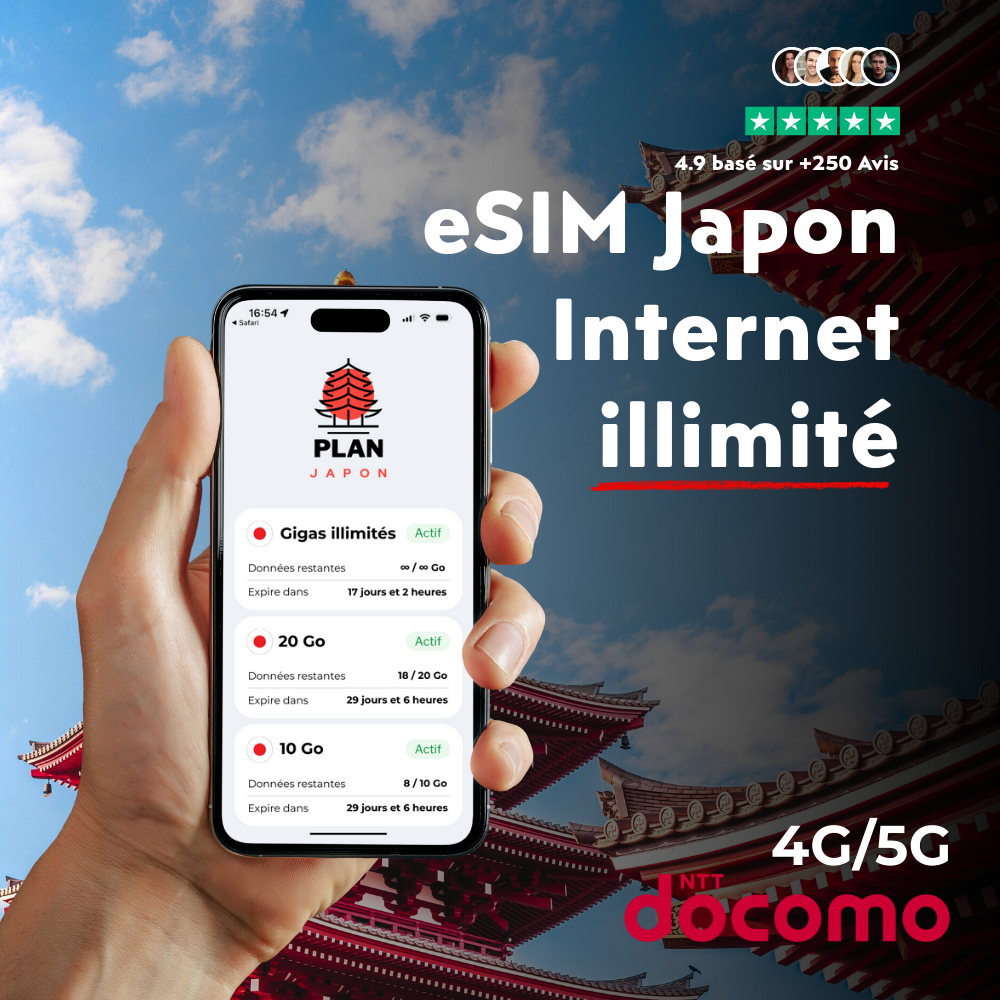
As soon as you land, your PlanJapan eSIM switches automatically to the NTT Docomo network: Google Maps works before you even leave the baggage claim, sparing you the queue at SIM counters (often 20 to 40 minutes at Narita) and the cost of a Pocket WiFi at ¥2,500 per day. Take advantage of the Visit Japan Web digital customs form (vjw.digital.go.jp), filed 72 hours before takeoff: it generates a QR code that cuts customs clearance from 20 to 30 minutes down to under 5. For travelers torn between the two airports, our detailed Narita vs Haneda comparison covers eSIM signal quality, available services, and the best landing slots.
The 12 essential districts: from Shibuya to Yanaka
Tokyo is lived by district, each with its own pace and architecture. Shibuya concentrates youth energy around the Shibuya Crossing — 2,500 pedestrians per green light cycle, or 500,000 per day. Climb Shibuya Sky (¥2,200, 230 meters high) at sunset for the 360° view across to Mount Fuji on clear days. Five minutes away on the JR Yamanote, Harajuku alternates the Takeshita-dori shopping street (youth fashion, Japanese crêpes) with the Meiji-jingu shrine, set in a forest of 100,000 trees planted in 1920. Shinjuku, seven minutes further, deploys its skyscrapers around the Tocho (metropolitan government building, free observatory on the 45th floor) and its nightlife labyrinth of Kabukicho, Golden Gai (six alleys, 200 micro-bars with 4 to 8 seats each), and Omoide Yokocho.
Asakusa and its Senso-ji temple — founded in 645, Tokyo's oldest — embody tradition. Arrive by 7 a.m. to photograph the giant Kaminarimon lantern crowd-free. Continue to Ueno-koen and its museums (Tokyo National Museum, ¥1,000, one of the world's five largest), then Yanaka, the district spared by the 1923 earthquake and the 1945 bombings, which keeps its shitamachi (old downtown) atmosphere with narrow lanes, cats, and craft workshops. Ginza displays luxury along its 13 blocks: Itoya for stationery, Mitsukoshi for depachika (department-store food basements), Ginza Six for contemporary fashion. Akihabara concentrates electronics and otaku culture (manga, anime, video games, maid cafés). Roppongi mixes international nightlife and culture (Mori Art Museum, ¥2,000). Odaiba, an artificial island in the bay, offers teamLab Planets (¥3,800), a life-size Gundam, and an urban beach. To compare eSIM coverage across all these districts, our deep dive eSIM Tokyo district by district documents precise network performance.
Getting around Tokyo: subway, JR, taxi, and bicycle
Tokyo's rail system is one of the world's most complex — 13 Tokyo Metro and Toei subway lines, plus around thirty JR and private lines (Keio, Odakyu, Tokyu, Seibu, Tobu). The network handles 8.7 million passengers a day with average punctuality under 30 seconds. The Suica IC card (rechargeable on smartphone via Apple Wallet or Google Wallet since 2023) or Pasmo gives contactless access to every line: top up ¥5,000 for 4 to 5 days of normal city usage. The JR Yamanote, the loop line connecting 30 key stations including Shinjuku, Shibuya, Tokyo, Ueno, and Akihabara, is your backbone: trains every 2 to 4 minutes during the day.
The Tokyo Metro 24h/48h/72h Pass (¥800/¥1,200/¥1,500) pays off from 4 rides per day. Avoid extreme rush hours (7:30 to 9 a.m., 5:30 to 7:30 p.m.) when cars hit 200% of official capacity — the famous pushers (oshiya) still operate at Shinjuku and Ikebukuro. Taxis (Nihon Kotsu, Hinomaru, Sojitz) charge ¥500 for pickup plus ¥100 every 233 meters, around ¥1,200 for 3 km — convenient in groups in the evening when the subway closes between 0:30 and 1 a.m. To cross Tokyo by bike, services like Docomo Bike Share or HELLO CYCLING offer ¥150 for 30 minutes via app — ideal around the Imperial Palace or along the Sumida. For navigation, Google Maps remains king but Japan Travel by Navitime shows times to the minute and precise platforms; we detail the best apps in our guide to essential travel apps for Japan.
Where to stay: matching budget and profile to district
Your district shapes your Tokyo rhythm. For a first visit, prioritize Shinjuku or Shibuya: maximum centrality, nightlife, and direct JR Yamanote access. Business hotels like APA, Toyoko Inn, or Sotetsu Fresa Inn offer functional 11 to 14 sq m rooms between ¥8,000 and ¥13,500 per night. For comfort, mid-range chains Mitsui Garden, JR Kyushu Blossom, or Daiwa Roynet step up to ¥16,000–22,000 with breakfast buffet. The much-coveted Park Hyatt Tokyo (the one from Lost in Translation, in Shinjuku) starts at ¥95,000 per night; Aman Tokyo, perched on the 33rd floor of Otemachi Tower, opens at ¥220,000.
For a more local experience, renovated machiya and guesthouses in Yanaka or Kuramae rent for ¥14,000 to ¥28,000 for 2 to 4 people. Modern capsule hotels (Nine Hours Shinjuku-North, The Millennials Shibuya, BOOK AND BED) offer design pods between ¥3,500 and ¥6,500 — perfect for solo travelers. High-end hostels like UNPLAN Shinjuku or Wise Owl Hostel Tokyo combine dorms (¥3,200) and private rooms (¥9,800) with coffee lobbies and flat workspaces. If you combine Tokyo with other Japanese cities, our 7-day Japan itinerary offers a balanced Tokyo–Kyoto–Osaka split, and our 10-day itinerary adds Hiroshima and Hakone. Book 3 to 6 months in advance for April and November when downtown availability drops below 8%.
Food and culture: from Michelin sushi to yokocho alleys
Eating in Tokyo means stepping into one of the densest gastronomic scenes in the world: 230 Michelin stars for the city in 2025, more than Paris and New York combined. Legendary sushi counters like Sukiyabashi Jiro (3 stars, ¥55,000 per person, hotel concierge booking six months in advance), Sushi Saito, or Sushi Yoshitake demand referrals and Japanese. For an accessible and delicious experience, opt for Sushidai at the Toyosu market (¥4,800 for 10 omakase pieces, queue starting at 6 a.m.), Sushizanmai (open 24/7, ¥3,000), or sushi-go-round Uobei and Genki Sushi (¥200 per plate, tablet ordering). For ramen, line up Ichiran Shibuya (¥980 for the tonkotsu bowl, individual booth), Afuri Roppongi (yuzu shio, ¥1,050), and Mendokoro Hanada Akihabara (tsukemen rated 4.3/5 on Tabelog).
The yokocho — alleys of micro-restaurants — embody Tokyo's nightlife soul. Omoide Yokocho in Shinjuku (60 stalls), Nonbei Yokocho in Shibuya (40 postwar bars), Ebisu Yokocho, and the Sangenjaya Sankaku-chitai triangle. Plan ¥3,000 to ¥5,500 for an evening with yakitori, draft Asahi beer, and improbable conversations. For cultural experiences, the sumo tournament (basho) lands in Tokyo in January, May, and September at Ryogoku Kokugikan (¥3,800–17,000); calligraphy (shodo) and tea ceremony workshops at Wabunka or Wak Japan cost ¥4,500 to ¥8,000 for 90 minutes. For pop-culture fans, teamLab Planets (¥3,800) in Toyosu and teamLab Borderless (¥3,800) at Azabudai Hills run the most Instagrammed immersive installations on the planet. Book two to three weeks in advance.
Day trips and final logistics: Hakone, Kamakura, Nikko, and budget
Tokyo is an excellent base camp for day trips. Hakone, 90 minutes by Romancecar (¥2,470) from Shinjuku, combines onsen, Mount Fuji views over Lake Ashi, the Owakudani volcano cable car, and an open-air museum. The Hakone Free Pass (¥6,100, 2 days) covers all local transport. Kamakura, 55 minutes on the JR Yokosuka Line (¥940) from Tokyo Station, holds the 11.4-meter Great Buddha (1252) and Hase-dera. Nikko, 2 hours on the Tobu Limited Express (¥3,050) from Asakusa, lists Toshogu (shogun Tokugawa Ieyasu's mausoleum) on the UNESCO World Heritage list and offers the 97-meter Kegon Falls. Mount Fuji is accessible from the fifth station by direct bus from Shinjuku (¥2,950, 2 h 30); the official climbing season runs from July 1 to September 10.
On global budget, plan ¥11,000 to ¥16,000 per person per day in comfort mode (business hotel, 3 meals, transit, 2 admissions), or ¥25,000 to ¥40,000 in premium mode (4-star hotel, kaiseki dinner, taxis). Currency exchange is far more favorable in Japan (7-Eleven banks, Japan Post Bank ATMs) than in Europe: withdraw ¥40,000 to ¥60,000 ahead and top up locally. Contactless payments (Apple Pay, Google Pay, and IC cards) work everywhere since 2023, but keep ¥5,000 in cash for smaller shrines and yokocho. A 20 or 50 GB eSIM is enough for 7 to 14 days of normal usage (Maps, photos, messages, occasional streaming); heavy users or family hotspots will prefer the unlimited eSIM, at about €4 a day over a week (€28.49 for 7 days). Combine with our full Kyoto guide to structure your cultural itinerary.
FAQ — Tokyo travel guide
How many days should I spend in Tokyo?
Four to five days is the minimum to cover the essential districts (Shinjuku, Shibuya, Asakusa, Ginza, Akihabara) and a day trip to Kamakura or Hakone. Seven days lets you add Nikko, Mount Fuji, and a freer day in Yanaka or Odaiba. For pop-culture, food, and shopping enthusiasts, you can easily fill 10 days without repeating yourself — Tokyo counts 23 wards with radically different atmospheres.
Is Haneda or Narita the better airport?
Haneda (HND) is clearly preferable: 14 km from downtown versus 60 km for Narita, transfers two to three times faster, and equivalent or lower fares. Air France and ANA now operate Paris–Haneda direct year-round. If you land at Narita, take the Narita Express or Keisei Skyliner rather than the bus — they offer far more predictable timing despite a slightly higher cost.
How much data do I need for 7 days in Tokyo?
For standard usage (Google Maps, photos, messaging, social media, occasional YouTube), 10 to 20 GB is plenty for a week. Plan 50 GB if you expect Netflix streaming on commutes, hotspot for a second device, or daily video calls. The unlimited eSIM remains the simplest option for digital nomads and families connecting 2 to 3 devices.
Does the PlanJapan eSIM work in the Tokyo subway?
Yes, the NTT Docomo network covers 100% of the 286 stations of the Tokyo subway and the JR Yamanote, including tunnels thanks to relay rollouts between 2018 and 2024. Internal tests measure a stable 4G signal in motion at 80 km/h on the Yamanote, with throughput of 25 to 60 Mbps. The few coverage drops are limited to certain deep stretches of the Oedo line and last under 20 seconds.
When is the best time to visit Tokyo while avoiding crowds?
May (after Golden Week ending May 6), June (just before tsuyu), early October, and late January offer a rare balance of acceptable weather, reasonable prices, and moderate crowds. Avoid April 28 to May 6 (Golden Week), August 13 to 16 (Obon), and December 29 to January 3 (Japanese New Year) when many sites close and intercity transport surges in price.
Do I need a Japan Rail Pass just for Tokyo?
No, the Japan Rail Pass is not worth it for a Tokyo-only stay: it costs ¥50,000 for 7 days, while intra-Tokyo trips run mainly on non-JR subway lines. Go for a Suica/Pasmo IC card and a Tokyo Metro 72h Pass (¥1,500) instead. The Rail Pass becomes attractive only if you combine Tokyo with Kyoto, Osaka, or Hiroshima.
Which apps should I download before leaving for Tokyo?
Download Google Maps (with the Tokyo offline map), Japan Travel by Navitime (precise to-the-minute train times), Google Translate (camera mode for menus), Visit Japan Web (customs form), Tabelog (restaurant reviews), and XE Currency for exchange. All run smoothly on the NTT Docomo 4G/5G eSIM, including underground.
Related articles:
- 7-day Japan itinerary: the balanced Tokyo–Kyoto–Osaka split
- Which eSIM to choose for Tokyo: network performance district by district
- The best season to visit Japan, month by month
- Kyoto travel guide: sites, transport, and budget
 Airalo
 Holafly
 Saily
Saily Nomad
Nomad Ubigi
Ubigi