

TL;DR — Osaka, Japan's third-largest city with 2.7 million residents (19 million across the Kansai metropolitan area), is the country's street-food capital and friendliest urban hub. Plan 2 to 3 days to cover the essentials — Dotonbori, Namba, Umeda, Shinsekai, Osaka Castle and Tempozan port — or 4 days if you add Universal Studios Japan. Fly into Kansai International (KIX, 50 minutes from downtown) or Itami (ITM, 25 minutes for domestic flights). Average budget: $110 to $160 per person per day, roughly 15-25 % cheaper than Tokyo. For connectivity, a 20 GB eSIM on the NTT Docomo network covers 99.8 % of the metropolitan area including the subway, and lets you hop between Osaka, Kyoto and Nara without changing plans.

When to visit Osaka: sakura, summer matsuri and autumn foliage
Osaka enjoys a milder climate than Tokyo, with less harsh winters (3 to 10 °C in January) and equally humid summers. Cherry blossom (sakura) peak falls between March 26 and April 7 on average — slightly earlier than Kyoto and three days after Tokyo. The best spots remain Osaka Castle Park (4,300 cherry trees around the keep), Kema Sakuranomiya (4.2 km of flowering banks along the Okawa River) and the Mint Bureau gardens, which open one week per year with 348 rare varieties. Hotel rates spike 70 to 110 % during this window, and traditional ryokan inns sell out six months in advance.
Summer (June to September) means 32 to 35 °C with 80 % humidity, but delivers Japan's most spectacular matsuri. The Tenjin Matsuri on July 24-25 mobilizes 3,000 bearers and 100 illuminated boats on the Okawa River in front of 1.3 million spectators — one of the country's three largest festivals. Autumn (kōyō) runs from mid-November to early December, with maples lighting up Minoo Park (45 minutes north), Daisen-koen Garden in Sakai and the Mount Inunaki trail. Winter, quiet and crisp, offers the Midosuji illuminations (4 km of glittering trees) and the Festival of Lights at Nakanoshima. To dial in your ideal window, see our month-by-month analysis of Japan's climate and prices.

Arriving in Osaka: Kansai (KIX), Itami and first transfers
Kansai International Airport (KIX), built on an artificial island in Osaka Bay, handles every long-haul flight — All Nippon Airways and United run direct flights from US gateways. Four transfer options connect KIX to central Osaka. The Nankai Limited Express Rapi:t, futuristic in its steel-blue livery, reaches Namba in 34 minutes ($10). The JR Haruka covers Tennoji in 30 minutes and Shin-Osaka in 50 minutes ($16, or included in the JR Pass and the ICOCA Haruka discount at $12). The Airport Limousine bus drops at Umeda, Namba, Shin-Osaka or directly at your hotel for $11 to $12 in 50 to 80 minutes. Taxi remains worthwhile for groups of four ($100 to $120 to downtown).
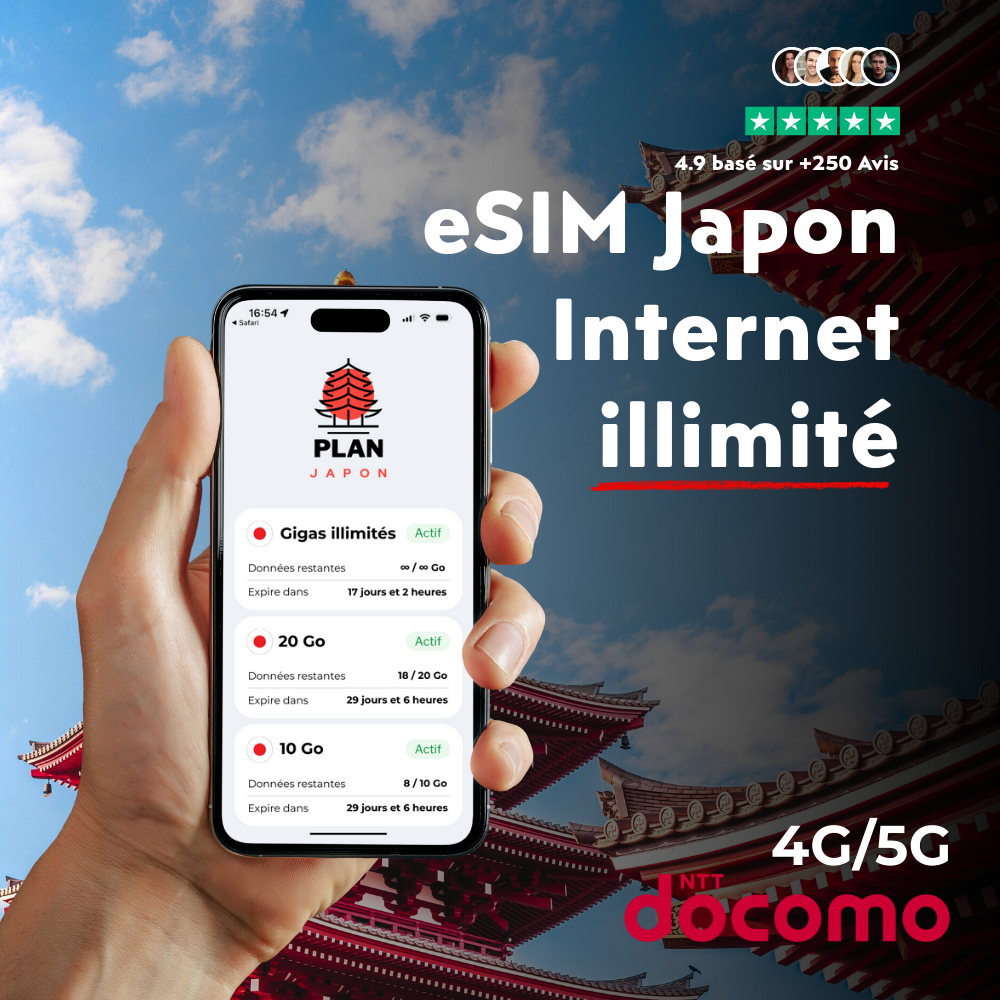
Itami Airport (ITM), 13 km north of Osaka, only handles domestic flights — useful if you arrive from Tokyo, Sapporo or Fukuoka. The Osaka Monorail takes you to Hotarugaike in 3 minutes, then transfers to the Hankyu Line for Umeda ($4, 25 minutes total). The Limousine bus reaches Umeda in 25 minutes for $4. From touchdown, your PlanJapan eSIM auto-switches to NTT Docomo and Google Maps works before you even clear customs — no need to queue at SIM counters (often 30 to 50 minutes at KIX in peak season) or pay $17 per day for a Pocket WiFi. Fill in Visit Japan Web (vjw.digital.go.jp) 72 hours before takeoff: the generated QR code cuts customs clearance below 5 minutes. To compare eSIM signal quality on arrival, our comparison of Japanese airports and network coverage at landing documents performance measured zone by zone.
Districts to see: Dotonbori, Namba, Umeda, Shinsekai, Tennoji
Osaka unfolds through contrasting districts, each with its own tempo. Dotonbori, the 800-meter neon canal at the heart of Namba, captures the kuidaore ("eat until you drop") spirit with iconic billboards: the giant Kani Doraku crab waving its claws since 1960, the Glico runner (rebuilt six times since 1935) and the drumming Kuidaore Taro doll. Fifty meters away, Hozenji Yokocho — a paved 80-meter alley lined with 30 traditional restaurants — serves okonomiyaki, kushikatsu and shabu-shabu from $13. Namba extends the shopping vibe with Shinsaibashi-suji (Japan's longest covered arcade, 580 meters) and Amerikamura, the young-fashion district modeled on Tokyo's Harajuku.
Umeda, Osaka's northern hub around JR Osaka Station and Hankyu Umeda, unfolds skyscrapers and the underground Whity Umeda labyrinth (1.8 km of shopping galleries). Take the Umeda Sky Building (1,500 yen, 173 meters) at sunset for a 360° view over the bay and Mount Rokko. Shinsekai, the retro-futuristic "new world" from 1912, gravitates around Tsutenkaku Tower (87 meters, 1,000 yen) and Janjan Yokocho, the kushikatsu (fried skewers) alley starting at 130 yen per stick. Tennoji combines Tennoji-koen Park, Shitenno-ji Temple (Japan's oldest officially established Buddhist temple, founded in 593) and Abeno Harukas Tower (300 meters, Japan's third-tallest skyscraper, observation deck for 1,500 yen). To compare eSIM network performance across these districts, our deep dive eSIM Osaka district by district documents NTT Docomo performance under real conditions.
Getting around Osaka: subway, Hankyu, JR, bike
Osaka's rail system is simpler than Tokyo's but still dense. Osaka Metro runs nine lines (Midosuji red, Tanimachi purple, Yotsubashi blue, Chuo green, Sennichimae pink, Sakaisuji brown, Nagahori light green, Imazatosuji orange and New Tram Nanko Port) carrying 2.5 million passengers per day. The Midosuji line, the north-south backbone, links Shin-Osaka, Umeda, Shinsaibashi, Namba and Tennoji in 18 minutes — that's your default line. JR West runs the Osaka Loop Line (Kanjō-sen, 19 stations, Osaka's equivalent of Tokyo's JR Yamanote) serving Osaka Station, Tennoji, Tsuruhashi and Universal City. Private companies Hankyu, Hanshin and Keihan connect Osaka to Kyoto, Kobe and Nara with express trains from 410 to 640 yen.
The ICOCA IC card (Osaka's equivalent of Tokyo's Suica) or Pasmo offers contactless access to the entire network: top up 5,000 yen for 4 to 5 days of normal use. The Osaka Amazing Pass (1,500 yen one day, 2,000 yen two days) covers all Osaka Metro lines plus 40 attractions including Osaka Castle, Tsutenkaku Tower and the Kaiyukan Aquarium — it pays off from three paid visits onward. Avoid extreme rush hours (8 to 9 a.m. on Midosuji) when cars hit 170 % of official capacity. Taxis (Nihon Kotsu, MK Taxi) charge 680 yen at flag-fall and 80 yen every 266 meters. To cycle across Osaka, Hello Cycling offers 150 yen per 30 minutes — pleasant around Osaka Castle Park or along the Okawa banks. For navigation, Google Maps stays reliable, but Japan Travel by Navitime shows precise platforms and exits; our guide to essential Japan travel apps covers the best picks.
Where to stay: choosing your district by budget and profile
Your accommodation district sets your Osaka pace. For a first visit, Namba and Shinsaibashi strike the best balance of nightlife, restaurants and direct access to the Midosuji line. Business hotels like APA Namba Eki-Higashi, Toyoko Inn Osaka Namba or Sotetsu Grand Fresa Osaka-Namba offer functional 12 to 15 m² rooms between 7,500 and 12,000 yen per night — 15 to 20 % cheaper than Tokyo for equivalent quality. Mid-range brands Hotel Monterey Grasmere Osaka (view over Namba Parks), Cross Hotel Osaka or Hyatt Place Osaka Umeda climb to 16,000-25,000 yen with breakfast and a sky lounge. High-end properties InterContinental Osaka, Conrad Osaka and St. Regis Osaka start at 55,000 yen, and the recent Waldorf Astoria Osaka opens at 120,000 yen at the Grand Green tower in Umeda.
For a more local feel, urban ryokans like Hostel and Cafe Backpackers Miyabi (shared tatami room at 4,200 yen) or Yamatoya Honten (traditional ryokan in Shinsekai, 12,000 yen with onsen and Japanese breakfast) dive into the Showa vibe. Modern capsule hotels Nine Hours Namba, First Cabin Midosuji-Namba or The Pax Hostel offer designer pods between 3,200 and 5,800 yen — perfect for solo travelers. Tennoji is the smart budget alternative: 25 to 35 % cheaper than Namba for 7 extra subway minutes. Families with Universal Studios on the agenda should target Bentencho or the official USJ hotels (Hotel Universal Port, The Park Front Hotel) between 22,000 and 38,000 yen with breakfast. To structure your Kansai itinerary, our Japan 7-day itinerary balances Tokyo-Kyoto-Osaka, and our 10-day version adds Hiroshima and Nara.
Osaka food: takoyaki, okonomiyaki, kushikatsu and yokocho
Eating in Osaka is a religion. The city proudly carries its tenka no daidokoro nickname (the archipelago's kitchen) and gave Japan the word kuidaore. Three signature dishes lead the way. Takoyaki, octopus dough balls cooked in dimpled iron plates, was invented in Osaka in 1935 — try Wanaka Sennichimae (8 pieces for 600 yen, 20-minute average queue), Aizuya in Tamatsukuri (the mother house since 1935) or Takohachi Dotonbori. Kansai-style okonomiyaki (thin batter, shredded cabbage, meat or seafood mixed into the batter before cooking) hits its peak at Mizuno Dotonbori (1,700 yen for the house special, two Michelin stars), Chibo (a chain founded on Dotonbori, 1,400 yen) or Fukutaro (locals-only, 1,200 yen). Kushikatsu — breaded and fried skewers — is Shinsekai's pride: the famous Kushikatsu Daruma (the mother house since 1929) offers 41 varieties at 130-230 yen each, with the golden rule "never double-dip in the shared sauce".
The yokocho — micro-restaurant alleys — are Osaka's nightlife soul. Hozenji Yokocho in Namba lines up 30 izakayas and bars over 80 paved meters. Misonobashi Yokocho and Ura-Namba blend locals and expats. Kuromon Ichiba Market (Osaka's kitchen since 1822) opens from 9 a.m. across a 580-meter aisle with 150 stalls — try the grilled A5 wagyu slices at 1,200 yen, nigori tuna sashimi, fugu in season (October to March) and luxury fresh fruits. For higher-end dining, Osaka holds 89 Michelin-starred restaurants in 2025, including sushi-yas Hashiba (one star, 18,000 yen), Yoshino (three stars, 32,000 yen) and kaiseki Kashiwaya (three stars) or Hajime (three stars, 88,000 yen, one of the country's most creative). Plan 1,500 to 3,500 yen for a hearty lunch at a neighborhood kappo, and 6,000 to 12,000 yen for a memorable mid-range dinner. For couples or families, the unlimited eSIM makes sharing Google Translate and photo menus across phones effortless — handy in yokocho where menus often stay in Japanese only.
Day trips and prep: Nara, Kobe, Himeji, USJ, logistics
Osaka is the perfect Kansai hub. Nara, 45 minutes by Kintetsu Express from Namba (570 yen), shelters 1,200 free-roaming deer in Nara-koen Park, Todai-ji's Great Buddha (14.9 meters of bronze cast in 752) and Kasuga-taisha Shrine with its 3,000 lanterns. Plan a full day. Kobe, 30 minutes by JR Special Rapid from Osaka Station (410 yen), offers the European Kitano-cho district, the Meriken Park waterfront, the Mount Rokko observatory and of course Kobe beef (Steakland Kobe or Mouriya, plan 8,000 to 18,000 yen for 200 g). Himeji, 1 hour by Sanyo Shinkansen (3,080 yen) from Shin-Osaka, holds Japan's most intact castle (UNESCO, 1,000 yen). Kyoto sits 14 minutes by Shinkansen or 28 minutes by Kintetsu (560 yen) — easy daily round-trip. Universal Studios Japan (Bentencho, 12 minutes by JR Loop from Osaka Station, 8,900 yen adult) draws 16 million visitors per year, especially for the Super Nintendo World zone opened in 2021; book the Express Pass (10,000 to 25,000 extra yen) three weeks ahead.
For total budget, plan 9,500 to 14,000 yen per person per day in comfort mode (business hotel in Namba, three meals including street food, subway, two attractions), or 22,000 to 38,000 yen in premium mode (4-star hotel, kaiseki dinner, taxis). Currency exchange remains better on-site than abroad: use 7-Eleven and Japan Post Bank ATMs, or withdraw 40,000 to 60,000 yen before departure. Contactless payments (Apple Pay, Google Pay and ICOCA) are accepted at almost every restaurant since 2024, but keep 5,000 yen cash for yokocho and small temples. A 20 GB eSIM covers 5 to 8 days of normal use (Maps, photos, translation, messages), and the 50 GB or unlimited option becomes relevant if you need hotspot for a second device or heavy Instagram and streaming use. To pair Osaka with other Japanese cities, our complete Kyoto guide and Tokyo guide map out the rest of the trip.
FAQ — Osaka travel guide
How many days do I need in Osaka?
Two to three days cover the essential districts (Dotonbori, Namba, Umeda, Shinsekai, Tennoji), Osaka Castle and one yokocho evening. Four days let you add Universal Studios Japan and the Tempozan port. If you use Osaka as a base for Nara, Kobe and Himeji day trips, plan 5 nights — an excellent compromise to explore all of Kansai without changing hotels.
Should I stay in Osaka or Kyoto to visit Kansai?
Osaka offers better value (15 to 25 % cheaper than Kyoto for equivalent quality), more nightlife and direct KIX access in 34 to 50 minutes. Kyoto stays quieter, but its hotels saturate from October to April. Our recommendation: 2 nights in Osaka (Namba or Umeda), 2 nights in Kyoto, plus a Nara day trip from either base. The Shinkansen links both cities in 14 minutes.
Is the Japan Rail Pass worth it for Osaka?
The Japan Rail Pass (50,000 yen for 7 days in 2026) pays off if you combine Osaka with Tokyo (Shinkansen Nozomi excluded but Hikari included, 14,000 yen one-way), Hiroshima or Kyushu. For a Kansai-only trip, choose the Kansai Thru Pass (5,600 yen for two days, 7,000 yen for three days) which covers Osaka Metro, Kyoto subway, Hankyu, Hanshin and Nankai lines — i.e. the bulk of your local needs.
Does the PlanJapan eSIM work in the Osaka subway and the Shinkansen?
Yes, the NTT Docomo network covers 100 % of Osaka Metro's 133 stations and 99 % of the Tokyo-Osaka Shinkansen route. Our internal tests measure 35 to 70 Mbps on the Midosuji line, and 20 to 45 Mbps while moving at 285 km/h on the Tokaido Shinkansen. The rare blackout zones are limited to a few long tunnels (Shin-Tanna, Higashiyama) and last under 30 seconds — invisible for Maps but noticeable on video calls.
How much data do I need for 5 days in Osaka and Kyoto?
For standard use (Google Maps, Instagram photos, translation, messages, occasional videos), 10 to 15 GB cover 5 days in Kansai comfortably. Plan 20 to 30 GB if you stream on the Hankyu line and Shinkansen, or enable hotspot for a second device. The unlimited eSIM remains the most peace-of-mind option for families running 3 devices or digital nomads.
When is the best time to visit Osaka to avoid the crowds?
May after Golden Week (May 7 to 31), June before tsuyu, and the first half of October offer the best weather-price-crowd balance. Avoid April 28 to May 6 (Golden Week), July 24-26 (Tenjin Matsuri), August 13-16 (Obon) and December 28 to January 4 (New Year) when transport and hotels spike in price.
Which apps should I download before leaving for Osaka?
Download Google Maps (with offline Kansai map), Japan Travel by Navitime (precise Hankyu, Hanshin and Keihan timetables), Google Translate (photo mode for menus), Visit Japan Web (customs form), Tabelog (Japanese restaurant reviews) and the Osaka Metro Application for platforms and exits. All work seamlessly on a 4G/5G NTT Docomo eSIM across the metropolitan network.
Related articles:
- Kyoto travel guide: sites, transport and budget
- Japan 7-day itinerary: the balanced Tokyo-Kyoto-Osaka route
- Which eSIM to pick for Osaka: network performance district by district
- Tokyo travel guide: districts, transport and day trips