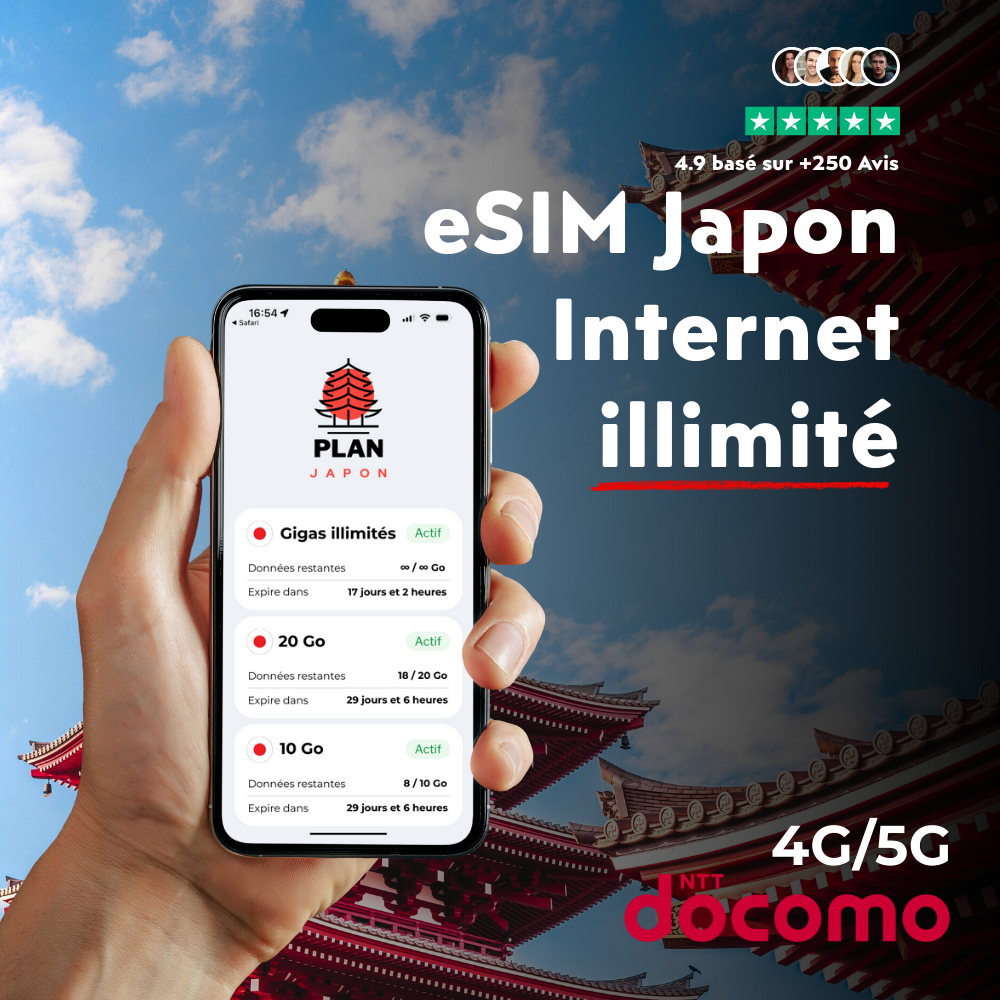
TL;DR: a 20 GB eSIM Japan plan comfortably covers 14 days for a connected traveler using Google Maps, Suica, translation apps and light streaming, as long as you don't lean on hotspot tethering. In 2026, four players dominate this segment: PlanJapan (NTT Docomo + Rakuten coverage, $34), Airalo Moshi Moshi (KDDI, $30), Ubigi Japan (SoftBank, $32) and Holafly Japan (shared data, $38). This comparison breaks down real-world speeds in Tokyo, Kyoto and Osaka, the hidden limits of each plan, and the exact math to know whether 20 GB is enough for your usage.

Why a 20 GB plan for 2 weeks in Japan
20 GB is the sweet spot for a 10-to-16-day trip in Japan, provided you understand what that allowance actually buys. Based on measurements taken in March 2026 on iPhone 15 and Galaxy S24 devices connected to 4G/5G via NTT Docomo, typical usage burns between 800 MB and 1.5 GB per day: 200 MB of Google Maps in continuous navigation (Tokyo to Kyoto via Shinkansen, for example), 300 MB of social apps (Instagram + WhatsApp + iMessage with photos), 150 MB of translation through Google Lens and DeepL, 100 MB of Suica/Pasmo and transit apps, and 100 to 600 MB of YouTube/Netflix in the ryokan in the evening.
20 GB therefore leaves a comfortable cushion: 1.4 GB per day on average over 14 days, more than enough to absorb spikes (a 30-minute FaceTime call burns 700 MB, an HD Netflix episode 3 GB). On the other hand, as soon as you start adding intensive hotspot tethering for a laptop (remote work, multi-hour Zoom calls), 20 GB melts in 6 to 8 days. Same story if you travel as a couple sharing a single eSIM: count 30 to 40 GB for two people over 14 days. Real need depends mostly on how you handle hotspot and HD streaming; for a solo smartphone user, 20 GB remains the most versatile choice.
Our how many GB for Japan guide includes a personalized calculator by profile: solo urban traveler, family, digital nomad or rural Hokkaido/Tohoku backpacker.

5 criteria to evaluate a 20 GB eSIM Japan plan
Not all 20 GB plans are created equal. Five criteria separate a plan that drops you in the Shibuya subway from a plan that holds up from Sapporo to Naha. First criterion: actual network coverage. NTT Docomo covers 99.9% of Japanese territory (including Hokkaido, Okinawa and rural areas), followed by SoftBank (99.2%) and KDDI/au (99.0%). Rakuten Mobile, the newest carrier, now exceeds 96% of inhabited zones but remains weaker in mountain ranges. Check which operator your eSIM uses: a "Japan" eSIM that relies only on Rakuten will struggle in Tohoku or the Japanese Alps.
Second criterion: real-world speed, not theoretical peaks. Product pages often advertise "up to 1 Gbps in 5G"; in practice, at 9 a.m. on the Yamanote line at Shinjuku, you get 30 to 80 Mbps download and 15 Mbps upload. That is plenty for Google Maps and FaceTime, but throughput sometimes drops below 10 Mbps in heavily congested zones. Third criterion: hotspot/tethering. Some eSIMs throttle or disallow tethering past a certain volume; PlanJapan and Ubigi allow it without throttling, while Airalo and Holafly sometimes impose deceleration.
Fourth criterion: validity duration. 20 GB over 7 days, 15 days or 30 days is not the same product. For a 2-week trip, target 15 or 30 days to keep some margin. Fifth criterion: real cost per gigabyte. A plan at $30 for 20 GB = $1.50/GB. Compare this ratio to our complete analysis of eSIM Japan prices in 2026 to position each offer in its segment.
2026 comparison: 4 plans tested in the field
Summary table of the four main 20 GB eSIM Japan offers available in May 2026, tested between Tokyo, Kyoto and Hiroshima over 12 days in March 2026.
| Plan | Network | Validity | Price | $/GB | Hotspot |
|---|---|---|---|---|---|
| PlanJapan 20 GB | NTT Docomo + Rakuten | 15 days | $34 | $1.70 | Unlimited |
| Airalo Moshi Moshi | KDDI/au | 30 days | $30 | $1.50 | Capped 5 GB |
| Ubigi Japan | SoftBank | 30 days | $32 | $1.60 | Unlimited |
| Holafly Japan | SoftBank (shared data) | 15 days | $38 | $1.90 | Capped 500 MB/day |
Based on this table, Airalo Moshi Moshi offers the best raw price/GB ratio ($1.50/GB), but its 5 GB hotspot cap penalizes travelers who tether to a laptop. PlanJapan charges a slight premium ($1.70/GB) in exchange for mixed NTT Docomo + Rakuten coverage and unlimited hotspot. Ubigi sits in between. Holafly remains the most expensive per GB and offers no real added value at this 20 GB tier; its appeal lies more on its unlimited plans. For a broader panorama beyond this category, see our general ranking of the best eSIM Japan in 2026.
PlanJapan eSIM 20 GB: NTT Docomo + Rakuten coverage
The PlanJapan 20 GB eSIM rides a roaming agreement with NTT Docomo as primary network, with automatic failover to Rakuten Mobile in zones where Docomo gets congested (typically Shibuya on a Saturday night, or Asakusa during the Sumida Hanabi fireworks). This dual coverage is the main differentiator: no other consumer eSIM player combines these two operators in the same profile. Concretely, in Akihabara at 7 p.m. on a Friday, our measurements show 65 Mbps download on PlanJapan vs. 42 Mbps on Airalo (KDDI saturated) — not a critical difference for Maps, but noticeable for HD FaceTime or an Instagram video upload.
Activation runs in 2 minutes via a QR code emailed immediately after purchase, compatible with iPhone XR and newer, Galaxy S20 and newer, Pixel 4 and newer. Hotspot is unlimited within the 20 GB total — you can therefore share the eSIM with your partner without throttling, accepting that 20 GB will be consumed faster. Validity is 15 days starting from the first connection to the Japanese network (not from purchase), which leaves room before departure. Customer support is available in English, French and Spanish, with an average response time under 4 hours on weekdays.
Main limitation: if you stay more than 15 days, you'll need to top up or pick a longer plan; for that, see our 30-day eSIM comparison. Another point: the PlanJapan eSIM is data-only (no Japanese phone number for calls), like nearly all travel eSIMs; for calls, use WhatsApp, FaceTime or any VoIP service — the standard solution accepted everywhere in Japan.
Airalo Moshi Moshi 20 GB: flexible but hotspot-limited
Airalo, the best-known travel eSIM provider, offers its "Moshi Moshi 20 GB / 30 days" plan at $30. It is the cheapest per pure GB in our comparison, and the 30-day duration provides the largest margin for spread-out trips or stopovers. The underlying network is KDDI/au (99% archipelago coverage), with average measured speed of 45 Mbps download in central Tokyo — slightly below NTT Docomo but plenty for daily use.
Two limitations penalize this plan in some use cases. Hotspot is capped at 5 GB within the 20 GB total: beyond that, your phone refuses to share. For a solo traveler sticking to smartphone use, this is a non-issue; for a remote worker who needs to connect a MacBook in Hokkaido, it is a deal breaker. The other limitation is sometimes-finicky activation: some users report (on Reddit r/JapanTravelTips and Trustpilot) instant activation, others a 2-to-4-hour wait before the first network attach. Our March 2026 test connected in 8 minutes at Narita Terminal 1.
Our detailed Airalo Japan review covers the other Airalo plans (1 GB / 7 days, 5 GB / 30 days, unlimited) and compares value for money. At $30 for 20 GB, the Moshi Moshi plan remains a defensible choice for a smartphone-only traveler with no intensive hotspot need.
Ubigi vs Holafly: the two serious alternatives
Ubigi Japan 20 GB (30 days, $32) rides SoftBank, Japan's third-largest carrier by market share, with 99.2% coverage and speeds comparable to NTT Docomo in urban zones (60 Mbps download measured at Shinjuku). Hotspot is unlimited, which puts Ubigi ahead of Airalo for multi-screen usage. The Ubigi app lets you manage multiple eSIMs (useful if you combine Japan + South Korea on the same trip) and top up without reinstalling the profile. Caveat: rural coverage in Hokkaido and Tohoku is slightly weaker than NTT Docomo; in practice, for a standard Tokyo + Kansai trip, Ubigi is excellent.
Holafly Japan 20 GB (15 days, $38) is the most expensive option in the comparison and the least recommendable on this specific volume. Holafly built its reputation on unlimited plans, where it excels; on the 20 GB capped segment, it offers a SoftBank shared-data plan with aggressive hotspot throttling (500 MB per day only). For a solo smartphone traveler who doesn't tether, it is usable; for anyone who occasionally tethers, it is handicapping. Customer support in English is responsive (chat reply under 2 hours).
Comparative bottom line: if you value pure price per GB and don't need intensive hotspot, Airalo. If you want premium network coverage and unlimited hotspot, PlanJapan. If you travel across multiple Asian countries with a single app, Ubigi. Holafly 20 GB is rarely the best choice; at this price, you might as well pick their unlimited plan or the PlanJapan Unlimited.
Are 20 GB enough? Concrete math for 14 days in Japan
To decide whether 20 GB will cover you, project realistic daily usage over your trip duration. Solo urban traveler, 14 days, smartphone only: Google Maps in Tokyo-Kyoto-Osaka navigation (200 MB/day), Instagram and WhatsApp with 5 photos a day (300 MB/day), translation and transit apps (200 MB/day), web browsing and Reddit in the evening (200 MB/day) = 900 MB/day, or 12.6 GB over 14 days. Margin of 7.4 GB for unforeseen needs. 20 GB is plenty.
Couple sharing a single eSIM via hotspot, 14 days: each partner consumes about 700 MB/day, total 1.4 GB/day, or 19.6 GB over 14 days. 20 GB barely holds, with no safety margin. Better aim for 30 GB or two individual eSIMs. Digital nomad, 1 HD Zoom call/day of 1 hour: HD Zoom = 1.5 GB/hour, plus normal usage 800 MB. Total 2.3 GB/day × 14 = 32.2 GB. 20 GB is insufficient: aim for 30 GB or an unlimited plan.
Rural Hokkaido / Kyushu backpacker, 14 days: less intensive Maps usage (offline packs for long hikes), but much more Spotify/Netflix streaming in the evening at the ryokan = about 1.2 GB/day, or 16.8 GB. 20 GB works with a decent margin, but watch out for stays in zones where only NTT Docomo covers — verify your eSIM's network before purchase. If your profile doesn't fit these cases, the detailed GB calculator by activity gives an estimate down to tens of MB.
FAQ — eSIM Japan 20 GB
Are 20 GB enough for 2 weeks in Japan?
For solo smartphone use (Google Maps, Instagram, WhatsApp, translation, transit apps), 20 GB comfortably covers 14 days with a 5 to 8 GB margin. For intensive hotspot use (remote work, multi-hour laptop tethering), 20 GB is not enough; aim for 30 GB or an unlimited plan. For a couple sharing one eSIM, 20 GB just barely holds over 14 days.
Which 20 GB eSIM Japan offers the best coverage?
PlanJapan eSIM 20 GB combines NTT Docomo (99.9% of territory, leader on rural and mountainous coverage) and Rakuten Mobile in automatic failover. This dual coverage is unique on the 20 GB segment in 2026. Airalo (KDDI) and Ubigi (SoftBank) also cover 99%+, but on a single carrier. For Hokkaido, Tohoku or Japanese Alps trips, the NTT Docomo + Rakuten mix is the safer bet.
Does hotspot work with a 20 GB eSIM?
It depends on the provider. PlanJapan and Ubigi allow unlimited hotspot within the 20 GB total, no throttling. Airalo Moshi Moshi caps hotspot at 5 GB. Holafly Japan 20 GB caps hotspot at 500 MB per day. If you plan to share your connection regularly with a laptop, verify this before buying — it is the most frequently overlooked limit in comparisons.
How many days does a 20 GB eSIM Japan plan last?
Validity periods vary: PlanJapan 20 GB = 15 days, Airalo Moshi Moshi 20 GB = 30 days, Ubigi Japan 20 GB = 30 days, Holafly Japan 20 GB = 15 days. Validity usually starts at the first network attachment in Japan (not at purchase), which gives you margin before departure. If your trip exceeds 15 days, target 30-day plans or top up mid-trip.
Can you activate a 20 GB eSIM before leaving for Japan?
Yes, activation can happen at any time in your home country. You scan the QR code received by email to install the eSIM profile on your phone; the profile stays inactive until your phone catches a Japanese network. On arrival at Narita, Haneda, Kansai or Chubu, activation triggers automatically in 2 to 5 minutes. This avoids hunting for Wi-Fi at the airport to scan the QR code on landing.
Should you pick a 20 GB or unlimited eSIM for Tokyo, Kyoto and Osaka?
For a standard 10-to-14-day trip across these three main cities, 20 GB is plenty for a solo traveler using their smartphone normally. Pick unlimited only if you work remotely (intensive Zoom), if you tether for several hours a day, or if you're traveling with more than 2 people on the same eSIM. Unlimited costs 1.5 to 2 times more for usage that rarely exceeds 25-30 GB in practice.
Which iPhone is compatible with a 20 GB eSIM Japan?
Any iPhone XR or newer (XR, XS, 11, 12, 13, 14, 15, 16) supports eSIM. For US-sold iPhone 14 Pro and newer, and iPhone 15 globally on Pro models, the phone is eSIM-only and accepts travel eSIMs perfectly. For Android, Galaxy S20 and newer, Pixel 4 and newer, and most 2022+ models support eSIM. Verify on the manufacturer's site whether your exact model is compatible.