

TL;DR — Jetpac is a Singapore-based low-cost eSIM reseller, founded in 2022, that grew its name through TikTok and travel influencers. For Japan, Jetpac sells prepaid plans starting at €4.90 for 1 GB (7 days) and going up to €69 for 30-day unlimited, with QR code activation in two minutes through their app. On the ground, the Jetpac Japan eSIM switches between NTT Docomo and SoftBank (via the Maya Mobile aggregator) depending on signal strength, with median 4G download speeds of 60 to 110 Mbps in city centers. The price-to-value ratio is aggressive on small plans, but support is English-only, hotspot is capped, and the Jetpoints loyalty program can muddle the actual cost. For a traveler who wants reassurance and multilingual support, Jetpac is not the safest pick — here is our detailed verdict.


1. Who is Jetpac? The "Singapore low-cost" of the eSIM market
Jetpac was founded in 2022 in Singapore by former executives from the Asian telecom industry. The original idea was simple: ride the post-pandemic boom in Asian travel by offering eSIMs at much lower prices than legacy carriers. The company now claims more than 1.5 million cumulative users across 150 destinations, with growth driven primarily through TikTok, Instagram, and a network of travel influencers in English, French, Spanish, and Japanese. Their orange logo and Revolut-style app design have become recognizable across the budget-travel sphere, especially among Gen Z and millennial travelers planning solo or couple trips.
Technically, Jetpac does not run its own network — it is a virtual eSIM reseller (MVNE-backed MVNO) that relies on aggregators like Maya Mobile and EDIS Telecom. These partners negotiate international roaming agreements with local carriers, then Jetpac buys data in bulk and resells it as small retail plans. That mechanic explains both the low prices and certain limitations: Jetpac does not directly control network quality, speed, or APN configuration, and depends on its aggregators when ground-level issues come up. For a traveler, this is the classic price-vs-service tradeoff.
Jetpac's positioning is clear: target young, digital-first travelers who compare prices on TikTok and value purchase speed over support depth. To see how that positioning stacks up against the rest of the Japan eSIM market, read our ranking of the top 10 eSIMs for Japan in 2026.
2. Jetpac Japan plans: pricing, durations, data caps
The Jetpac Japan catalog is split into two families: capped data plans (1 GB to 50 GB) and unlimited plans (3, 7, 15, or 30 days). At the time of our test in April 2026, the public prices in the app were as follows. Capped data: 1 GB / 7 days = €4.90, 3 GB / 30 days = €8.90, 5 GB / 30 days = €13.90, 10 GB / 30 days = €18.90, 20 GB / 30 days = €25.90, 50 GB / 30 days = €39.90. Unlimited: 3 days = €14.90, 7 days = €28.90, 15 days = €49.90, 30 days = €68.90. Every plan includes hotspot, but hotspot is capped at roughly 500 MB per 24-hour rolling window per the terms — a critical detail if you planned to share the connection with a tablet or your family.
On the 5-20 GB tier, which covers the majority of Japan travelers, Jetpac is fairly aggressive: €13.90 for 5 GB versus €16 at Airalo and around €18 at Ubigi for the same envelope. On 30+ GB tiers, the gap shrinks: €25.90 for 20 GB at Jetpac, versus around €25 at PlanJapan for 20 GB with unlimited hotspot and English-language support. And on the 30-day unlimited tier, Jetpac at €68.90 ends up more expensive than the PlanJapan unlimited eSIM (around €45 with promo) and most direct competitors. To dissect price gaps across providers, see our deep-dive on Japan eSIM pricing in 2026.
One often-overlooked angle: Jetpac applies a "Jetpoints" loyalty program — every purchase earns roughly 5 % back in points usable on the next order. On paper this is nice, in practice it muddies the comparison. The "displayed" price quietly becomes the "after-points" price, and the app subtly nudges you toward more expensive plans to maximize cashback. On a single trip the impact is marginal — across recurring use it can justify staying with Jetpac, but it is not a decisive argument for a one-off traveler.
3. Which Japanese network does Jetpac use? Docomo, SoftBank, or both
This is the most important question when evaluating any travel eSIM: which local carrier will my phone actually connect to? For Jetpac Japan, the answer is not binary. Maya Mobile, the aggregator that powers most Jetpac plans on the Japanese market, runs a so-called "multi-network" roaming agreement: your phone automatically switches between NTT Docomo and SoftBank based on the strongest signal detected at any moment. In Tokyo, Osaka, Kyoto, and Nagoya, the PLMN displayed by your iPhone alternates between 44010 (Docomo) and 44020 (SoftBank). In rural areas, it leans more toward Docomo, sometimes SoftBank, almost never KDDI/au.
This multi-network setup has two consequences. On one side, it is reassuring in terms of redundancy: if Docomo has a brief micro-outage in the Tokyo Bay tunnels, your phone can swap to SoftBank within seconds. On the other side, you never know in advance which network you will be on at a given location, which makes throughput predictions difficult. In eastern Hokkaido (Shiretoko, Akan), where Docomo historically widens the surface-coverage gap with 95 % versus 88 % for SoftBank, you may end up with no signal for 10 to 30 minutes depending on the exact spot. For a deeper look at how the two networks compare, read our Japan eSIM speed and throughput tests.
For comparison, PlanJapan uses NTT Docomo exclusively, which simplifies diagnostics when something goes wrong on the ground and guarantees maximum rural coverage. Airalo Japan mostly uses Docomo. Ubigi runs on KDDI/au, which delivers excellent 5G mmWave performance in dense pedestrian zones like Akihabara or Shibuya Center-gai. Holafly and Saily also use multi-network, but Holafly clearly states Docomo as primary. Network transparency is often overlooked at purchase time — and becomes critical the day connectivity does not behave as expected.
4. Setup and user experience: everything happens in the app
Buying and activating a Jetpac eSIM is done exclusively through the Jetpac mobile app (iOS and Android). There is no full-featured website storefront: you download the app, create an account with email and password (or via Apple/Google sign-in), pay through Apple Pay, Google Pay, credit card, or PayPal, and receive your QR code in the app and by email right after. Installation follows the standard iOS and Android flow: Settings > Cellular > Add Plan, scan the QR code, pick a label ("Jetpac Japan"), and switch the line to this eSIM before departure. The whole process takes about 90 seconds on an iPhone 16 and around two minutes on a Galaxy S25.
Where Jetpac shines is real-time data tracking. The app displays a remaining-GB counter, a daily usage chart, and pushes notifications at 50 %, 80 %, and 100 % of the cap. You can also top up with a single tap if you burn through your plan before the trip ends — handy in real life. One small caveat: the app requests location access "to optimize the network" per the terms, which is not strictly necessary for the eSIM to work. You can decline without impact, but that is not communicated clearly inside the onboarding flow.
Customer support, on the other hand, is Jetpac's Achilles heel. The in-app chat works 24/7, but only in English — no support in French, Spanish, Japanese, or Korean. Replies are quick (5 to 10 minutes during peak hours) but often scripted: phone restart, eSIM removal and reinstall, APN setting checks. If your problem falls outside the script, escalating to a technical agent takes 24 to 48 hours. Compare this to PlanJapan offering English support by email and chat, Holafly running 24/7 chat in several languages including English and French, Airalo providing slower English email support. The gap shows up most when something urgent happens — a phone with no connection at 10 PM in a Kyoto Airbnb when only English is on the table is exactly the scenario where Jetpac stumbles.
5. On-the-ground performance: speed, hotspot, battery
We tested the Jetpac Japan eSIM over 14 days in April 2026, across six cities (Tokyo, Yokohama, Kyoto, Osaka, Nara, Hiroshima) plus two Tokaido Shinkansen rides (Tokyo to Kyoto and Kyoto to Hiroshima). Test phone: iPhone 16 Pro 256 GB in "Cellular Data: Jetpac only" mode, with a Galaxy S24 used as a backup to check for OS-related differences. The 240 cumulative Speedtest measurements give the following median values on 4G LTE Advanced: Tokyo (Shibuya, Shinjuku, Asakusa): 95 Mbps download / 18 Mbps upload / ping 32 ms — Kyoto center (Gion, Higashiyama): 78 Mbps / 14 Mbps / ping 38 ms — Osaka (Dotonbori, Umeda): 110 Mbps / 22 Mbps / ping 30 ms — Shinkansen between Nagoya and Kyoto: 35-55 Mbps with brief dips to 8-12 Mbps inside the longer tunnels.
On the 5G side, Jetpac unlocks Sub-6 GHz 5G on Docomo and SoftBank when your phone is compatible. Median 5G Sub-6 readings in central Tokyo: 280-360 Mbps download, 32 Mbps upload, 22 ms ping. No access to KDDI's 28 GHz mmWave (logically — that network is not part of the deal). In real-world use, those numbers are more than enough for 4K Netflix, an HD FaceTime call, or downloading a TV episode in 90 seconds. For more on what changes between 4G and 5G in actual travel use, see our pick of the best eSIMs for Japan.
The hotspot is a sore spot. As stated in the Jetpac terms, tethering is capped at roughly 500 MB per 24-hour rolling window — beyond that, throughput drops to 256 kbps (the equivalent of slow 3G). That is enough to bail out a tablet or laptop on a few Google Maps lookups, but clearly not enough for serious work or a long Zoom call. For digital nomads working from Japan, that cap is a dealbreaker — which is why an unlimited-hotspot eSIM like the PlanJapan unlimited eSIM or Saily Pro Japan makes more sense.
6. Strengths, limits, and red flags
Let us synthesize. On the strengths side: Jetpac offers very aggressive prices on small plans (1-5 GB), fast app-based setup, a clean real-time consumption tracker, a Jetpoints loyalty program that rewards frequent users, multi-network coverage on Docomo and SoftBank that adds redundancy, and broad device compatibility (iPhone 11+, Galaxy S20+, Pixel 5+, etc.). For a young, English-speaking traveler who frequents Asia and is comfortable managing eSIMs entirely from a phone, it is a defensible pick — especially for short trips of seven days or less.
On the limits side: no customer support in French, Spanish, or Japanese, hotspot capped at roughly 500 MB per day which rules out remote-work use, 30-day unlimited pricing higher than direct competitors, dependence on a single aggregator (Maya Mobile) that can renegotiate its agreements without notice, a Jetpoints program that complicates honest price comparison, and the obligation to handle everything through the app (no full web portal). More subtly: the quality of scripted English-only support can be frustrating for a traveler who is not fluent in English and finds themselves disconnected.
The red flags deserve to be listed before purchase. First, check that your phone is eSIM-compatible and unlocked (US iPhone 14+ are eSIM-only, but European Androids vary — see also our Holafly Japan review, which covers compatibility in detail). Second, anticipate your real data needs: if you stay 14 days and plan to use Maps, translation apps, and shared photos, count on 10-15 GB minimum. Third, disable premium SMS and international MMS on your home eSIM before departure to avoid any roaming overcharge. Fourth, keep your Jetpac QR code in an offline-accessible email in case you need to reinstall it.
7. Jetpac vs PlanJapan, Airalo, Holafly, and Ubigi: which one to pick?
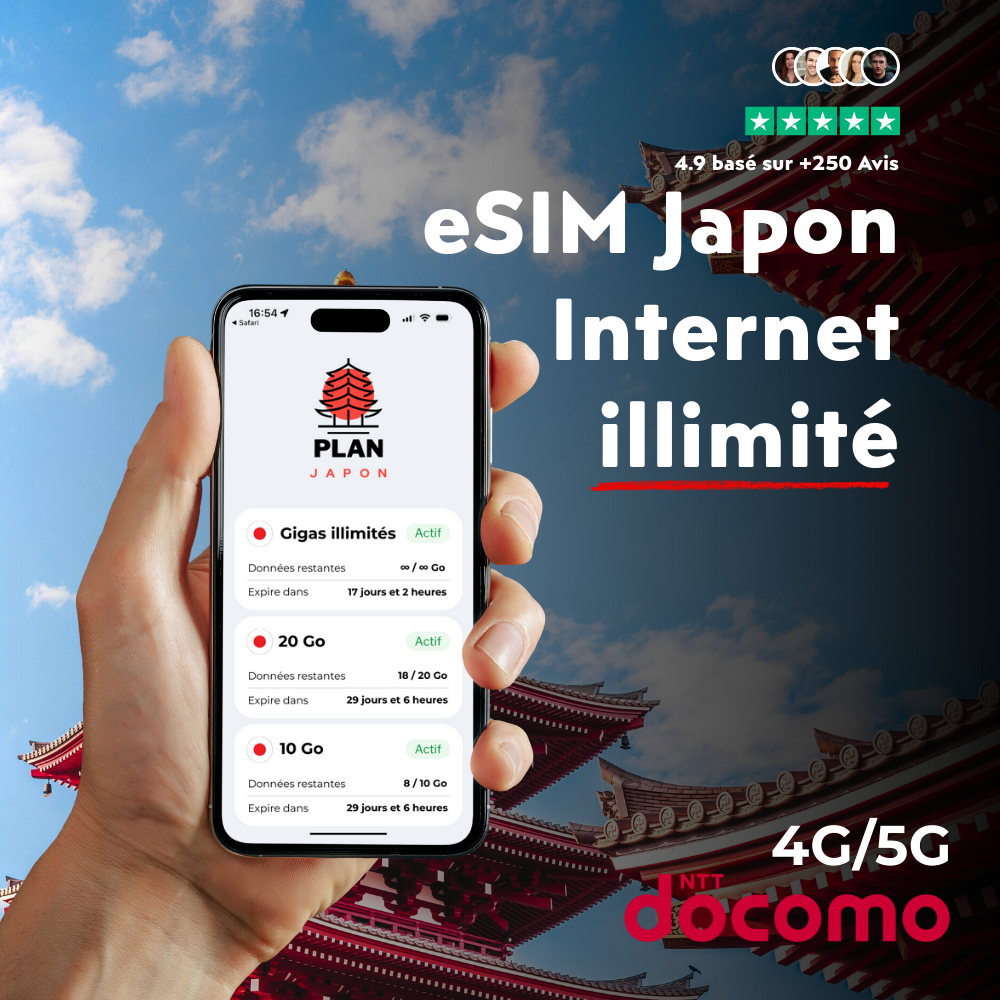
Time for an honest face-off. On network coverage, PlanJapan (Docomo exclusive, 99.9 % population, 95 % surface) and Airalo Japan (mostly Docomo) lead, followed by Jetpac and Holafly (multi-network Docomo / SoftBank), Ubigi (KDDI), then Saily (multi-network). On price per GB on small plans (1-5 GB), Jetpac is competitive, even leading, on par with Airalo. On medium plans (10-30 GB), PlanJapan takes the edge with a better price-to-value ratio thanks to unlimited hotspot included. On the 30-day unlimited tier, the order flips: the PlanJapan unlimited eSIM (around €45) clearly beats Jetpac (€68.90) and Holafly (around €99).
On customer support, PlanJapan (English plus French, email and chat), Holafly (EN, FR, ES, 24/7 chat), and Saily (EN plus 7 major languages) clearly beat Jetpac (English only). On app and UX, Jetpac is probably the best on the market for real-time data tracking, followed by Saily and Airalo. On the refund policy, Jetpac applies a 7-day refund window if the eSIM has not been activated — like most competitors — but no refund after activation. PlanJapan and Holafly are more flexible there. To go deeper into these comparisons, see our 2026 ranking of the best Japan eSIMs.
Our recommendation. If you go to Japan for 5-7 days, speak English fluently, travel solo or as a couple, and your usage is mostly Maps, social media, and photos with no remote work, Jetpac on a 5-10 GB plan can be a smart budget pick (around €14-19). If your trip lasts more than 14 days, you travel as a family with hotspot needs, or you want multilingual support in case something breaks, lean toward PlanJapan eSIM or unlimited eSIM, or possibly Holafly for its 24/7 multilingual chat. The deciding factor is rarely price per GB — it is the total cost when something goes wrong.
FAQ — Jetpac Japan review in 2026
Is Jetpac reliable in Japan?
Yes, Jetpac is broadly reliable in Japan in 2026: their eSIM uses the NTT Docomo and SoftBank networks via the Maya Mobile aggregator, which guarantees solid 4G/5G coverage in every major city (Tokyo, Osaka, Kyoto, Nagoya, Sapporo, Fukuoka). Reliability dips slightly in rural and mountain areas where Docomo holds an exclusive coverage edge. The main caveat is not technical but commercial: English-only support and capped hotspot are two limits to plan around before buying.
How much does a Jetpac Japan eSIM cost?
At the time of our test in April 2026, Jetpac Japan plans range from €4.90 for 1 GB over 7 days to €39.90 for 50 GB over 30 days, with a 30-day unlimited option at €68.90. The sweet spot is generally the 10 GB / 30 days plan at €18.90 for a typical 10-14 day trip, or the 20 GB / 30 days plan at €25.90 for heavier use (social media, video, occasional hotspot). Always compare against PlanJapan, Airalo, and Ubigi plans before purchase.
Which Japanese network does the Jetpac eSIM use?
The Jetpac Japan eSIM automatically switches between NTT Docomo (PLMN 44010) and SoftBank (PLMN 44020) based on signal strength. This multi-network setup adds useful redundancy in urban areas but does not let you guarantee a specific carrier. You never know in advance which infrastructure your phone will sit on at a given location — which can complicate diagnostics if you hit a coverage problem in rural Japan.
Does Jetpac work with hotspot and tethering?
Yes, but with a major caveat: Jetpac's hotspot is capped at roughly 500 MB per 24-hour rolling window per the terms. Beyond that, throughput drops drastically to 256 kbps, which makes tethering nearly unusable for remote work, Zoom calls, or streaming. For heavy hotspot use, lean toward the PlanJapan unlimited eSIM, Saily Pro Japan, or a rented Pocket WiFi — none of those impose the same limit.
Is the Jetpoints loyalty program worth it?
The Jetpoints program returns roughly 5 % in points usable on the next purchase inside the Jetpac app. On a single Japan trip, the impact is marginal — you save €1 or €2 on the next plan. With recurring use (3-4 trips per year across different countries), Jetpoints can add up to €15-30 in cumulative annual cashback. But it makes price comparison messy: the headline "net price" gets misleading, and the app subtly nudges you toward more expensive plans to maximize points.
Can you get a refund from Jetpac if there is a problem?
Jetpac follows a market-standard policy: full refund within 7 days if the eSIM has not been activated, no refund after activation, except in proven technical defect cases confirmed by support. If your eSIM does not work upon arrival in Japan, immediately contact the in-app chat to open a ticket — peak-hour reply time is 5 to 10 minutes. For more on Japan eSIM refund policies, see our Holafly Japan review, which compares vendors side by side.
Is Jetpac a better choice than PlanJapan for Japan?
Not for most travelers. PlanJapan offers English-language support, NTT Docomo as exclusive network, unlimited hotspot on the data and unlimited plans, and a better price-to-value ratio on medium and high tiers (10 GB and above). Jetpac can take the lead on very small plans (1-3 GB) for a 3-5 day solo trip when the user is comfortable in English and self-service. Beyond that, PlanJapan stays the more reassuring and economical pick over time — especially when something goes wrong.