

TL;DR
Summer in Japan (June–September 2026) combines extreme heat, the rainy season, and spectacular festivals. Between photos and videos of matsuri, constantly checking the weather, searching for air-conditioned spots, and GPS navigation through Obon crowds, your data consumption skyrockets. An unlimited eSIM on the NTT Docomo network guarantees you a reliable connection without counting gigabytes — even at the summit of Mount Fuji or on the beaches of Okinawa.
Why Summer 2026 Will Be a Record Season in Japan
Japanese summer has never attracted more international travelers. With the yen remaining favorable, direct flights from Europe, and a festival calendar among the richest in the world, June–September 2026 is shaping up as a peak tourist season.
But summer in Japan is also a demanding season. Temperatures regularly exceed 35°C in Tokyo and Osaka, with a feels-like temperature above 40°C due to humidity. The rainy season (tsuyu) covers all of June and part of July. And mid-August, Obon transforms the entire country into a massive migration — packed trains, fully booked hotels, crowded streets.
In this context, your smartphone becomes your survival tool: real-time weather checks, finding the nearest air-conditioned cafe, verifying disrupted train schedules, photographing matsuri and sharing everything with loved ones. All of this consumes data — a lot of data.
Summer Festivals: Your Biggest Data Consumers
Gion Matsuri — Kyoto (all of July)
Japan's most famous festival spans the entire month of July, peaking on July 17 and 24 during the float parades (yamaboko). Kyoto's streets are flooded with hundreds of thousands of visitors. You'll need GPS, photos and videos, real-time restaurant searches, and possibly live streaming.
Sumida River Fireworks — Tokyo (last Saturday of July)
Tokyo's biggest fireworks display attracts nearly a million spectators. Everyone photographs, films, and posts simultaneously. On the NTT Docomo network, coverage is scaled for this type of peak. On a secondary roaming network, much less guaranteed.
Nebuta Matsuri — Aomori (August 2–7)
One of the most visually impressive festivals in Japan. Giant illuminated floats (nebuta) parade every evening. Count 500 MB to 1 GB per evening if you're actively filming and posting.
Awa Odori — Tokushima (August 12–15)
Japan's largest dance festival, on Shikoku island. NTT Docomo's coverage on Shikoku is significantly better than SoftBank or KDDI in peripheral areas.
Obon (August 13–16): Japan on the Move
Obon isn't a single festival but a period when all of Japan returns to their hometown. Trains are packed, highways jammed. For you, that means constant schedule checking, last-minute reservations, and waiting in stations consuming data.
With a plan limited to 10 or 20 GB, these intense festival days can exhaust your allowance in just a few days. That's why we recommend the unlimited plan for any summer stay in Japan.
Extreme Heat: Impact on Your Phone and Data Use
Your Battery Drains Faster
Lithium-ion batteries lose efficiency above 35°C. An iPhone or Samsung that normally lasts a full day can drop to 60–70% of its usual battery life in Japanese summer heat.
Tips to preserve your battery in summer:
- Keep your phone in the shade — not in your back pocket in direct sunlight
- Use battery saver mode below 40%
- Bring a power bank (10,000 mAh minimum, 20,000 mAh recommended)
- Avoid charging in direct sunlight
You're Constantly Searching for Air Conditioning
This is a summer-specific data use: finding a nearby air-conditioned spot. Google Maps, Tabelog, konbini apps — you're constantly searching for somewhere to cool down. Summer travelers spend on average 30 to 50% more time on their phones than spring or fall travelers.
Rainy Season and Weather Alerts: Why Connectivity Is Vital
Tsuyu: The Rainy Season (June – mid-July)
The rainy season hits most of the archipelago. Rain is often sudden and intense, requiring you to check weather forecasts multiple times a day via JMA, Weather Japan, or Windy apps. Train lines can be suspended in heavy rain — you need to check operator websites constantly.
Typhoons (August–September)
Typhoon season starts in August and intensifies in September. A typhoon in Japan means cancelled flights, stopped Shinkansen, closed shops. Your smartphone becomes your command center: tracking the typhoon, finding alternative accommodation, contacting your insurance, airline, and hotel.
Losing your connection during a typhoon means losing your ability to react. This is the scenario where an unlimited eSIM most justifies its investment.
For coverage details on the southern islands, check our guide on the eSIM in Okinawa.
Summer Hikes and Beaches: NTT Docomo Coverage in Remote Areas
Mount Fuji (Open July 1 – September 10)
NTT Docomo covers the main Fuji stations (5th station and above) and mountain huts. You'll have network to share your sunrise (goraiko), check the weather, and contact emergency services if needed.
Okinawa and Pacific Coast Beaches
NTT Docomo coverage is excellent on all major beaches — Naha and Chatan in Okinawa, Kamakura and Enoshima near Tokyo, Shimoda on the Izu Peninsula. Coverage extends to the Kerama Islands (Zamami, Tokashiki), popular for snorkeling.
Unlimited eSIM or Fixed Plan: Which One for Summer in Japan?
| Usage | Estimated daily consumption |
|---|---|
| Google Maps + navigation | 200–500 MB |
| Photos/videos shared (social media) | 500 MB – 1 GB |
| Video streaming (1h) | 500 MB – 1.5 GB |
| Weather checks + alerts | 100–200 MB |
| Messaging (WhatsApp, LINE) | 100–200 MB |
| Restaurant/activity searches | 100–300 MB |
| Total active summer use | 1.5 – 3.5 GB/day |
Over a 14-day summer trip, that's 20 to 50 GB — and more if you film festivals or a typhoon forces emergency replanning.
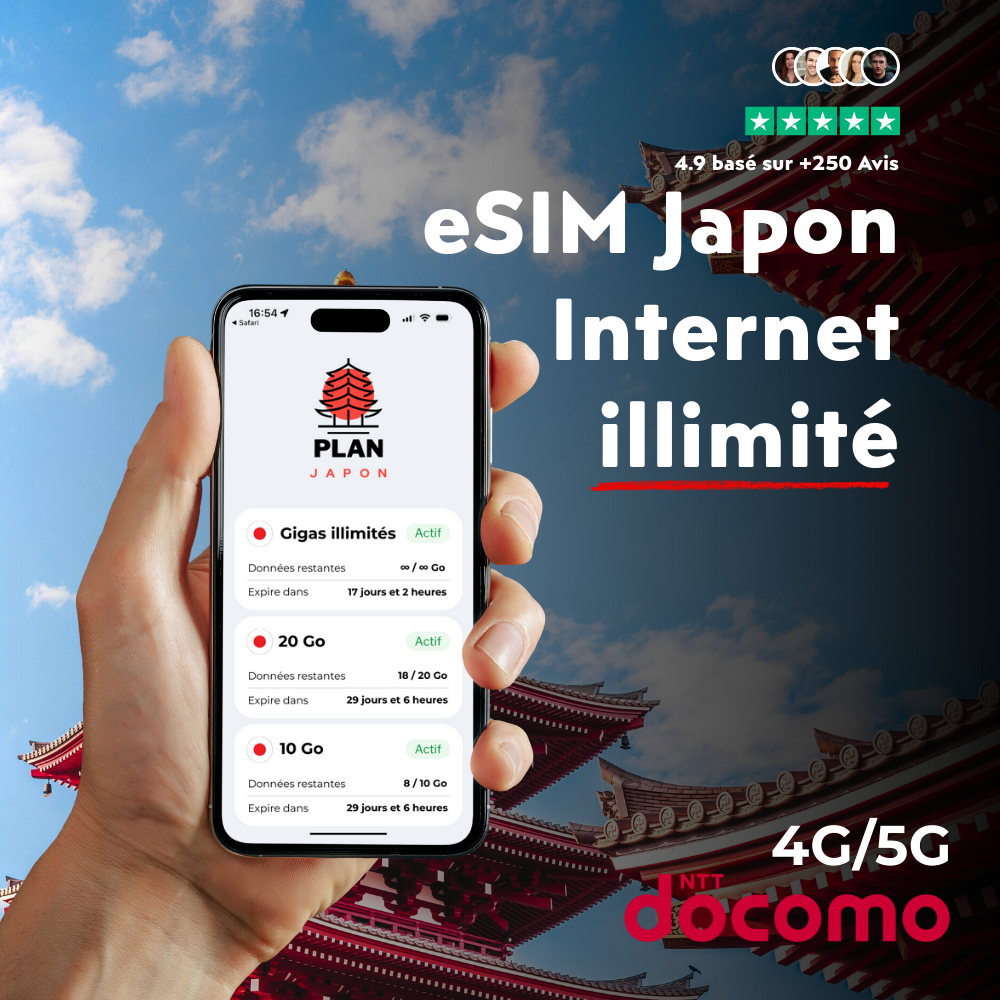
With the PlanJapan unlimited eSIM, you don't have to cut hotspot sharing, skip filming at an exceptional festival, count remaining GB, or decline a video call with family back home. NTT Docomo delivers consistent 4G/5G speeds — no throttling, no hidden fair-use cap.
For details on data consumption, check our article eSIM Japan: how many GB do you need?
Frequently Asked Questions
Does the eSIM work during festivals even when it's crowded?
Yes. NTT Docomo scales its antennas for high-attendance events like Gion Matsuri or Sumida fireworks. You'll always have network, even among hundreds of thousands of people. Speeds may drop slightly at absolute peak moments, but the connection stays functional for Maps, messaging, and social media.
Can heat damage my eSIM?
No. The eSIM is a chip built into your phone — it doesn't fear external heat as long as your phone works. However, if your smartphone enters thermal protection mode, data connection is temporarily cut. Keep your phone in the shade.
Is there network at the summit of Mount Fuji?
Yes, NTT Docomo covers the 5th station, mountain huts, and the summit. Coverage is sufficient for messages, photos, and weather checks. Video calls may be unstable above the 8th station.
Which eSIM plan for a 3-week summer in Japan?
For a 3-week summer trip (festivals, hikes, beaches), we strongly recommend the unlimited eSIM. The combination of intensive photos/videos, constant weather checks, and GPS navigation in crowds easily pushes consumption beyond 50 GB over 3 weeks. With unlimited, you stop worrying.
Does the eSIM work on Okinawa's beaches?
Yes. NTT Docomo covers all major Okinawa beaches (Naha, Chatan, Onna, Nago) as well as popular islands like Zamami and Tokashiki in the Kerama chain.
What if a typhoon cancels my flight during my trip?
This is exactly the scenario where a reliable data connection is indispensable. With your eSIM, you can contact your airline, search for alternative flights or accommodation, track the typhoon in real time, and check authorities' instructions — all without depending on a potentially overloaded hotel Wi-Fi.
Our Recommendation
Summer in Japan is an extraordinary season — but also the most demanding for your connectivity: heat draining your battery, festivals exploding your data consumption, typhoons requiring a reliable backup connection.
Our advice for summer 2026:
- Choose the PlanJapan unlimited eSIM — it's the only option that frees you from all constraints during the most intense weeks of the year in Japan
- Bring a 20,000 mAh power bank — heat reduces your phone's battery life by 30 to 40%
- Install your eSIM 2–3 days before departure, calmly — not at the airport in a rush
- Enable JMA alerts upon arrival to be warned of heavy rain or typhoons
Japanese summer is meant to be lived intensely. With an unlimited connection on the NTT Docomo network, you enjoy every matsuri, every beach, every Fuji sunrise — without ever worrying about your data.
 Airalo
 Holafly
 Saily
Saily Nomad
Nomad Ubigi
Ubigi